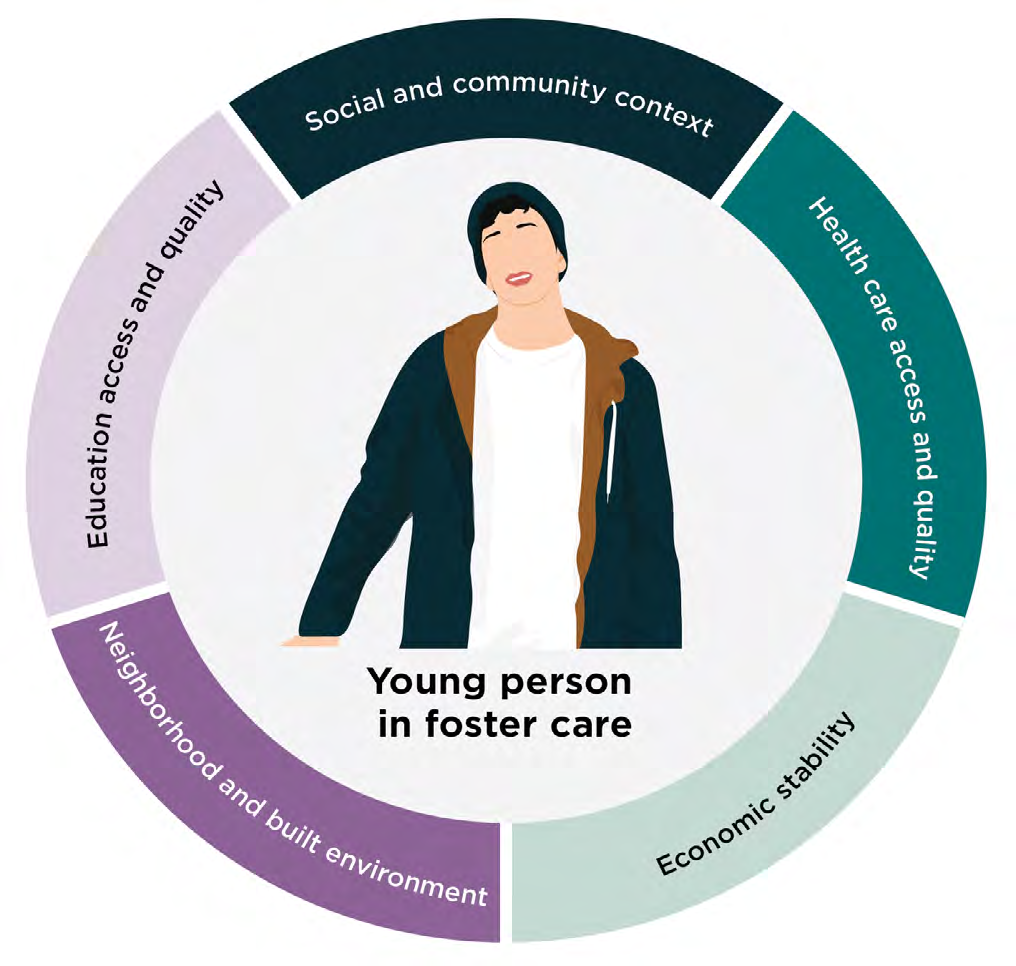
The following tips accompany our resource, Incorporating the Social Determinants of Health in Practice to Address Sexual and Reproductive Health for Young People Involved in Foster Care. We worked with both youth-supporting professionals and youth with lived expertise in foster care to identify practice tips for navigating the social determinants of health when working with youth in foster care. These tips cover a range of social conditions that may arise when talking to youth about pregnancy prevention and related sexual and reproductive health topics. While each general practice tip applies across all social determinants of health, we provide examples of how to apply these tips within specific social determinant categories in our full resource.
Ensure that young people have someone with whom they feel safe discussing sexual and reproductive health.
Caseworkers should help young people identify a medical provider or school staff member with whom they feel safe speaking about sexual and reproductive health.
Tailor information to individual young people and ensure that these conversations are responsive to a range of experiences.
Caseworkers can help young people by providing relevant resources and tailoring sexual and reproductive health information to individual young peoples’ needs, experiences, and communities.
Always make space for youths’ input and let them drive the conversation.
Caseworkers can help young people by consistently making space for youths’ input in, and ownership of, conversations about sexual and reproductive health and allowing them to control the conversation.
Do not assume anything about the young person’s sexual behaviors or knowledge.
Caseworkers can help young people by refusing to make assumptions and judgements about young people’s sexual behaviors and knowledge.
Ensure that conversations are non-punitive. Young people cannot feel worried that they will get in trouble for being honest.
Caseworkers can help young people by assuring that conversations about sexual and reproductive health are not punitive and remain confidential (unless the topic requires mandated reporting) and ensuring that young people do not experience negative consequences stemming from honest conversations and attempts to seek help.
Present all available options and let the young person pick what works for them, or what they’re most comfortable with at that moment—even if some options conflict with the caseworker’s personal beliefs.
Caseworkers can help young people by presenting all available options (e.g., contraceptive options) and helping them select an appropriately tailored sexual and reproductive health service and/or health aide that makes them feel most comfortable at the time.
Ensure that conversations are held in the young person’s preferred language and address language barriers (e.g., offer resources and handouts in the young person’s preferred language, hire an interpreter).
Caseworkers can help by ensuring that young people have access to interpreters or staff skilled in a range of languages to engage in conversations.
Build a broad network of professionals to connect young people within communities.
Caseworkers can help by cultivating a network of professionals with whom young people can connect to ensure that youth receive relevant and helpful information.
Provide preventative care and conversations. Don’t just reach out when something happens.
Caseworkers can help by connecting young people to preventative care while in foster care and ensuring that sexual and reproductive health care is built into case plans and discussed with young people.
Provide access to resources such as transportation or financial support for services.
Caseworkers can help by providing transportation to appointments or providing bus passes for young people. Additionally, caseworkers should ensure that young people can afford any co-pays, prescriptions, or other follow-up needed to access sexual and reproductive health services.