Overview
This brief summarizes available research on seven dimensions of access to sexual and reproductive health care. Our goal is to inform youth-supporting professionals about the complexity of access for youth who have experienced the child welfare and/or justice systems, homelessness, and/or disconnection from school and work (i.e., opportunity youth). Understanding the dimensions of access is critical to supporting the sexual health of—and preventing unintended pregnancy among—young people with these experiences.
Below are the key takeaways from this brief.
- There are three phases of access to sexual and reproductive health care—discovering, seeking, and receiving—which are comprised of seven dimensions that further explain whether and how youth access sexual and reproductive health care.
- Understanding the seven dimensions of access can help youth-supporting professionals increase access to sexual and reproductive health care services among the youth they serve.
- Research and resources specific to youth who have experienced the child welfare and/or justice systems, homelessness, and disconnection from work/school are limited.
- Changing contexts make it difficult to track current policies and their impacts on access to sexual and reproductive health care among youth.
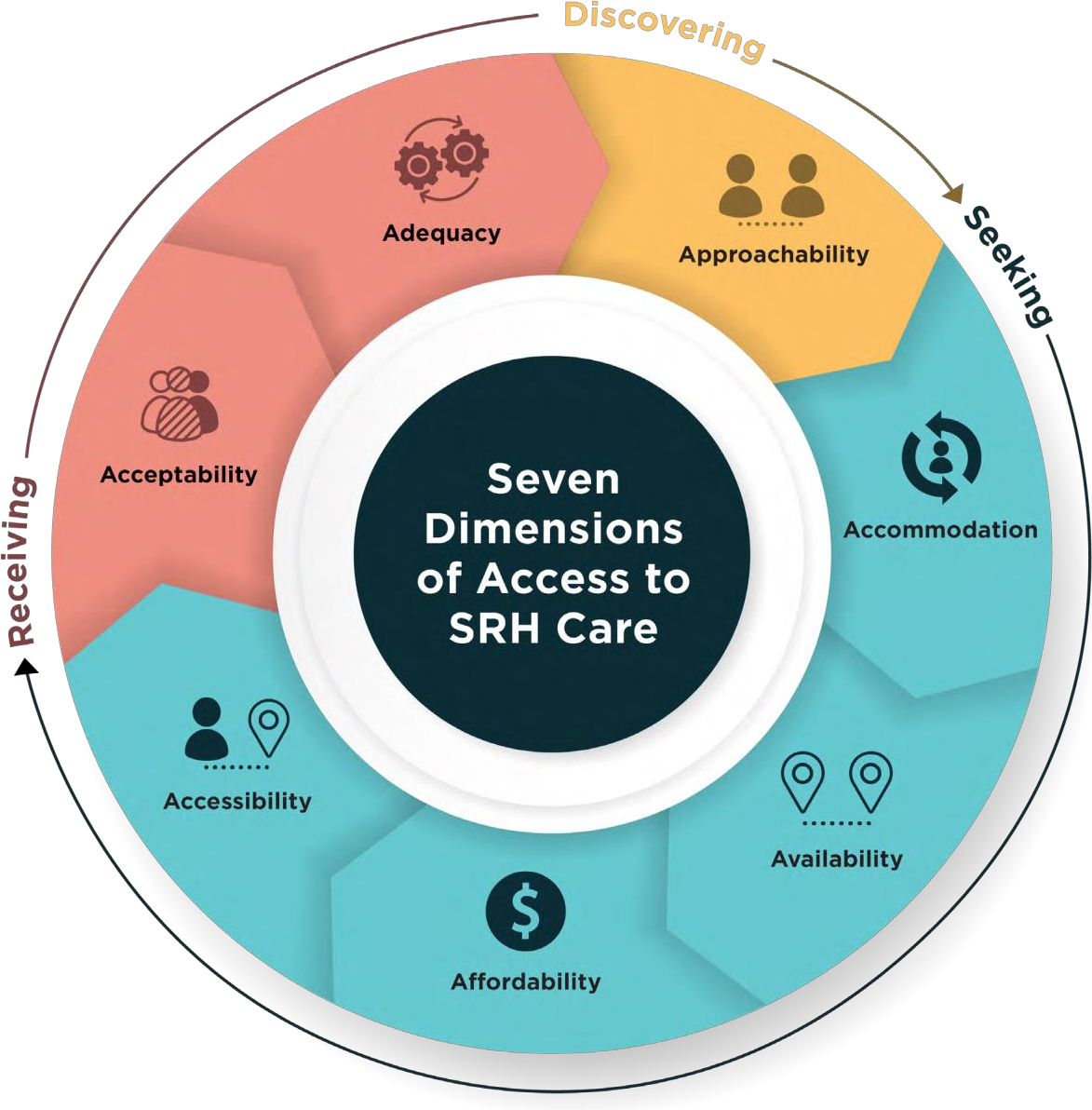
We begin with background information on why access to sexual and reproductive health care is important for youth who have experienced the child welfare and/or justice systems, homelessness, and/or disconnection from school and work. Next, we define the seven dimensions of access, drawing upon two conceptual frameworks, and describe our methods for developing the research summary. Then, we discuss each dimension and related literature from the past five years. Last, we consider and reflect on practice implications for youth-supporting professionals. The contents of this research summary are relevant to youth-supporting professionals who want to increase access to sexual and reproductive health care among these young people regardless of the setting in which they work.
Background
In the United States, an estimated 4.2 million youth and young adults experience homelessness each year,1 about 110,000 youth and young adults ages 13 and older are in foster care on a single day,2 nearly 25,000 youth are held daily in a juvenile justice facility,3–5 and 4.7 million youth ages 16 to 24 are disconnected from work or school.6 Despite their unique needs, youth with these experiences often lack access to essential health care, including sexual and reproductive health care (e.g., contraception, STI treatment, prenatal or postnatal care, etc.).7–10 Moreover, when they do access sexual and reproductive health care, youth often report being stigmatized and judged by providers who lack empathy or whose care is not youth-centered.11,12
Individual, community, and system-related challenges constrain efforts to promote sexual health among young people who have experienced the child welfare and/or justice system, homelessness, and/or disconnection.7,13–15 For example, youth involved in the child welfare or justice systems report challenges accessing condoms or sexual health information, limited knowledge about sexual health, and policies that restrict their access to sexual and reproductive health care services.9,16,17 Barriers like these are associated with increased sexual risk-taking (i.e., unprotected sex, early sexual debut), unintended pregnancies, STI transmission, and less frequent receipt of prenatal and postpartum care relative to their peers.18–21
Providing access to sexual and reproductive health care includes educating youth to inform their decision making, equipping them with resources to make informed decisions, and providing them with trauma-informed services tailored to their unique needs. Access to sexual and reproductive health care can help young people avoid unintended teen pregnancy.
Findings
Seven dimensions of access to sexual and reproductive health care
We conceptualize access to sexual and reproductive health care using seven overlapping and interconnected dimensions (Table 1), organized into three phases: discovering, seeking, and receiving. During the discovering phase, young people must be aware that a service or provider exists to meet their needs. During the seeking phase, young people consider whether the provider accommodates their individual needs, whether the services they need are available and affordable, and whether the physical location of the provider is accessible. During the receiving phase, young people focus on the quality of care offered and whether their provider considers their individual background and experiences. Thinking about these three phases of access may help professionals support and increase young people’s access to sexual and reproductive health care.
These dimensions are drawn and adapted from two conceptual frameworks related to health care access. The first was published by Penchansky and Thomas in 198122 and the second was published by Levesque and colleagues in 2013.23 The frameworks conceptualize access as multi-dimensional—a function of the fit between the characteristics of health care providers and the characteristics of health care users. Many of the dimensions overlap, but there are instances where new dimensions were identified in the later framework developed by Levesque.
| Dimension | Definition | Example | ||
|---|---|---|---|---|
| Facilitator | Barrier | |||
| Discovering | Approachability | Extent to which health care providers make young people aware of their existence | A clinic does targeted outreach to youth experiencing homelessness through a street outreach program using peer educators. | No mention of youth-specific services on the provider’s website or written materials. |
| Seeking | Accommodation | Extent to which health care providers consider young people’s needs and preferences, as well as the constraints that limit their options | A clinic is open until 7:00 pm on weeknights and from 9:00 am to 4:00 pm on Saturdays for youth. | The clinic is by appointment only with limited hours. |
| Availability | Extent to which providers offer the health care services youth need | A school-based health center provides sexual and reproductive health care services to students. | A school-based health center only provides condoms in the waiting area. | |
| Affordability | Extent to which the cost of health care services is aligned with the youth’s ability to pay | A clinic offers a sliding scale fee for young people who are uninsured. | Youth must pay a co-pay before a service is provided. | |
| Accessibility | Extent to which the location of services is reachable | A clinic is centrally located with easy access to public transit. | A clinic is in a remote location only accessible by car. | |
| Receiving | Acceptability | Extent to which health care providers recognize, consider, and honor cultural, social, and individual factors that influence care | A health care provider uses motivational interviewing to assess a youth’s sexual health needs. | A health care provider develops a care plan without consulting the young person. |
| Adequacy | Extent to which health care services are appropriate, timely, integrated, and continuous | A clinic offers youth care coordinators to follow-up on the visit and connect to other resources. | A young person is given a list of services with no referral or follow-up call. | |
Discovering
 Approachability: The extent to which health care service providers make young people aware of their existence
Young people cannot access sexual and reproductive health care services of which they are not aware. Likewise, youth-supporting professionals cannot refer youth to health care services that they do not know about. Awareness requires targeted outreach efforts by health care providers to youth and the professionals who support them.24 Young people need to know that health care services exist and can improve their health,22 while youth-supporting professionals must have up-to-date information about health care services to which youth can be referred. One study by Beal and colleagues (2020) found that providing youth in foster care with youth-informed educational materials—including information about health care providers, sexual and reproductive health, and appropriate levels of care—increased their self-reported health care utilization.25 Based on their interviews with service providers about access to health care among youth experiencing homelessness, Gallardo and colleagues (2020) recommended enhancing the approachability of services by intentionally identifying young people’s health care needs and linking them to appropriate services.24
Seeking
 Accommodation: The extent to which service providers consider young people’s needs and preferences, as well as the constraints that limit their options for care
Health care services are often delivered in ways that are not youth-centered (i.e., a lack of consideration for school, work, or other commitments that limit availability; use of medical jargon or technical terms difficult to understand; or requiring in-person visits to be seen). For example, youth experiencing homelessness and youth in foster care may not have learned how to identify a health care provider, schedule a medical appointment, or otherwise navigate the health care system.24,4 Lack of knowledge about their personal and family medical history can make it difficult for these young people to complete medical intake forms.24,27 Youth experiencing homelessness may have trouble accessing health care services because many lack a state ID or proof of health insurance.24 Limited availability of walk-in appointments, hours that conflict with young people’s school or work schedules, and the lack of a primary health care provider lead many youth experiencing homelessness to rely on emergency departments for their health care.24,28,29
 Availability: The extent to which providers offer the health care services youth need
The availability of sexual and reproductive health care is affected by policies that either mandate or restrict access.24,30 Some policies affect youth involved in a particular system. For example, a study conducted in 2021 across 17 juvenile detention and committed centers in California, Maryland, and Georgia found variation in the services provided to pregnant youth, even though all facilities offered obstetric and gynecological care. These discrepancies resulted in differing availability of on- or off-site OB/GYNs, pregnancy testing, and abortions (including the requirement of judge approval).31 Meanwhile, youth who are under court supervision but not incarcerated are left to address their sexual and reproductive health on their own, since they are not protected under the same mandates as those in detention facilities that require such care.10,32
 Affordability: The extent to which the cost of services is aligned with young people’s ability to pay
Health insurance coverage is a primary determinant of sexual and reproductive health care affordability, particularly for youth.22,33 Young people are typically covered by Medicaid while they are in foster care and continue to be eligible for Medicaid until their 26th birthday if they age out of care.25 Young people involved with the justice system may have access to sexual and reproductive health care while they are detained or incarcerated but may lack health insurance when they are living in their communities, which can result in discontinuity of care.33,34 Young people experiencing homelessness may be covered by their parent/caregiver’s insurance but may not possess proof of insurance or other important documentation needed to utilize their coverage.35 They may also be eligible for Medicaid if they live in a state that has enacted Medicaid expansion, although several states have declined to expand Medicaid in recent years.35,36 In 2010, the Patient Protection and Affordable Care Act expanded access to health insurance among young people and required that contraception and some preventative sexual and reproductive health services are covered by insurance; however, young people must be insured to take advantage of this.36 The Hyde Amendment and additional state laws prohibit the use of federal funds and federally funded health care for abortion care, except in cases of rape, incest, or a life-threatening pregnancy.
Out-of-pocket expenses such as coinsurance payments, as well as transportation costs, can also limit young people’s ability to access sexual and reproductive health care.22,37 To mitigate issues related to affordability, Gallardo and colleagues found that health care providers used funds from multiple state and federal grants and collaborated across health care organizations to address the health care needs of youth experiencing homelessness.24
 Accessibility: The extent to which the location of services is reachable
The physical location of a clinic is an important factor to consider for youth. Lack of transportation can be a barrier for youth who don’t live near a clinic and rely on family or friends or public transportation to get to appointments.38–40 Youth are also vulnerable to sudden moves to communities where sexual and reproductive health care is inaccessible, which can interrupt the continuity of their care. For example, youth in foster care may be moved from one placement to another, youth experiencing homelessness may be forced to move due to shelter stay limits, and youth in the juvenile justice system may be moved from a detention facility back into the community.26,41–43 In addition to a clinic being centrally located or reachable by public transit, it is necessary to account for the physical safety of the environment for youth. Current research does not specifically discuss physical safety related to accessing sexual and reproductive health care, but it has been linked to whether youth decide to engage in a program or access a service of any type.44 Although studies have shown that telehealth can increase the accessibility of sexual health services and information for adolescents,45 a study of young people experiencing food and housing insecurity found that they perceived greater barriers to accessing contraceptives via telehealth than their peers.46
Receiving
 Acceptability: The extent to which health care service providers recognize, consider, and honor cultural, social, and individual factors
Youth view health care as more acceptable when providers are respectful, nonjudgmental, and work to establish trust.30,47–49 A history of trauma is common among youth experiencing homelessness, or in the child welfare and juvenile justice systems.24 Health care providers who understand the impact of trauma on young people’s behaviors may demonstrate the flexibility and open-mindedness needed in their interactions with youth to avoid retraumatizing them.24 Confidentiality and privacy are also critical to young people’s perceptions of health care acceptability.10,31,50 Health care may be perceived as unacceptable if youth fear that a provider will notify their parent or caregiver (e.g., relative or foster parent)14,32,51,52 or if they are required to disclose information about their sexual or reproductive health to others, such as a caseworker or attorney, as a precondition of access.30,53 Sexual and reproductive health is a sensitive topic where youth are often met with adult disapproval, judgment, or stigma toward their decisions or questions around their sexual health.
 Adequacy: The extent to which the health care services provided are appropriate, timely, integrated, and continuous
High mobility among youth experiencing homelessness reduces their likelihood of repeated encounters with the same health care provider. High mobility challenges youth who experience homelessness to maintain comprehensive medical records, coordinate care across health care settings, and/or establish strong relationships between providers and youth.24 However, youth who experience the justice system benefit from continuity of care through integrated systems, including public health and court systems. Health care providers and youth-supporting professionals struggle to offer consistent, continuous, and coordinated care to youth who experience the child welfare and/or justice systems, homelessness, and/or disconnection from school and work due to a lack of knowledge about confidentiality and Health Insurance Portability and Accountability Act (HIPAA) laws.32 Overall, there is limited literature on the adequacy of sexual and reproductive health care services for youth across these populations.
Reflections
Our review of the literature on the seven dimensions of access to sexual and reproductive health uncovered relatively little to no research related to health care access among youth who are disconnected from school and work. While youth who are disconnected were not specifically identified in the literature, we are aware that they may overlap with other populations (i.e., youth experiencing homelessness, involved with the child welfare systems, etc.) and may be represented within those findings. In addition, access to sexual and reproductive health care is highly dependent on the state in which youth live and on the systems in which they are involved.
The literature we reviewed points to several strategies that could be implemented by health care service providers to increase access to sexual and reproductive health care for youth who have experienced the child welfare or juvenile justice systems, homelessness, or disconnection. Youth-supporting professionals outside of the clinical space could also benefit by using the dimensions to assess organizations and/or providers to which they refer young people.
| Phase | Strategy to implement or identify when assessing services for youth |
|---|---|
| Discovering |
|
| Seeking |
|
| Receiving |
|