This tip sheet is for youth-supporting professionals who work with young parents who have experienced the child welfare or juvenile justice systems, homelessness, or disconnection from work and school. Its purpose is to provide guidance to these professionals about ways to help young parents and their adult caregivers navigate adolescent parenthood.
Overview
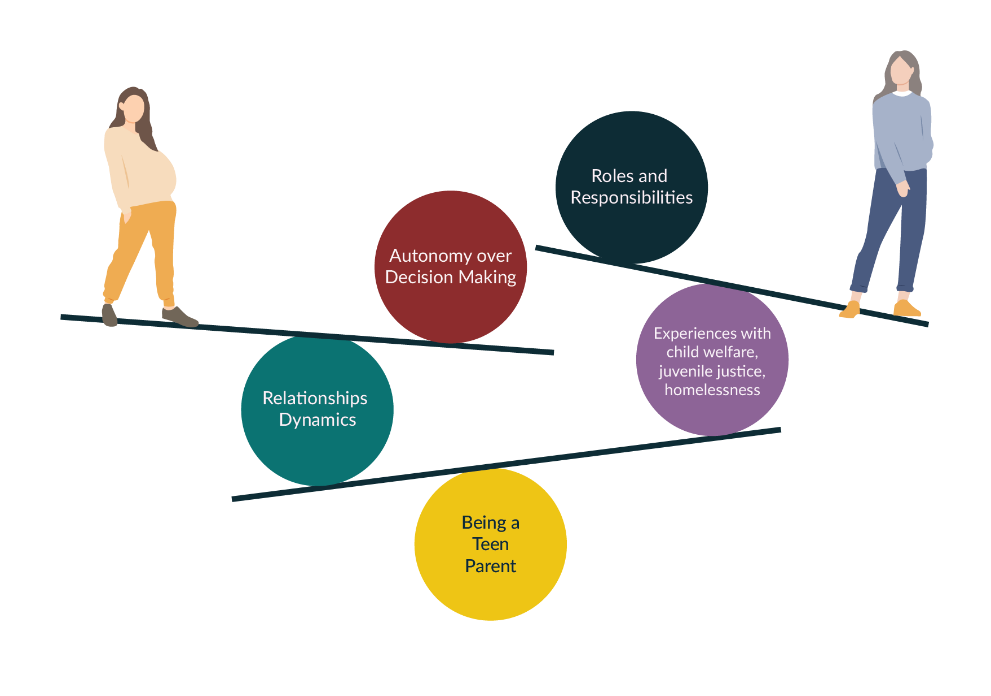
As adolescents seek greater levels of independence, conflict and negotiation with their adult caregivers are developmentally appropriate.1,2 When adolescents become young parents, their relationship dynamics with their adult caregivers change further.3,4 As summarized in our research brief, young parents find themselves having to balance shifting relationship dynamics and assume new roles and responsibilities, while adult caregivers may find themselves having to give young parents more autonomy and decision-making power.5,6,7 These changes require both young parents and their adult caregivers to interact and communicate differently. The relationship between young parents and their adult caregivers may be especially complex when the young person has experienced the child welfare or juvenile justice systems, homelessness, or disconnection from school and work.8,9
Supporting healthy family dynamics and relationships between young parents and their adult caregivers is essential. When young parents are supported, they can thrive and demonstrate the resilience needed to overcome the challenges and stigma often associated with young parenthood.10 Investing in the relationship between young parents and their adult caregivers can have a positive effect not only on the young parent but also on the well-being of their young child.11,12 Youth-supporting professionals can serve as the link between young parents and their adult caregivers and help strengthen their relationships.
The table below highlights strategies youth-supporting professionals can implement when working with young parents and their adult caregivers, whether directly or indirectly.
Opportunities for professionals to support young parents and their adult caregivers
Educate young parents and caregivers on adolescent development
- Connect with adult caregivers to help them understand their role as the young parent transitions into adulthood.
- Develop or share resources that explain the key features of adolescent development, particularly around adolescents’ increased desire for independence.
- Promote positive parenting strategies and disciplinary practices.
Promote young parents’ self-efficacy13
- Use strengths-based language to help promote growth and increase young parents’ confidence in parenting.
- Encourage caregivers to make space for young parents’ decision-making autonomy.
- Set achievable goals and celebrate young parents’ achievements.
Foster strong, healthy youth-adult relationship dynamics14
- Identify behaviors and patterns that may contribute to conflict between young parents and their caregivers.
- Encourage family nights and activities to create opportunities for positive memories.
- Provide opportunities for young parents and caregivers to safely, non-judgementally, and respectfully share their feelings about young parenthood.
Equip young parents and adult caregivers with strong communication skills
- Connect young parents and their adult caregivers to programs that focus on adolescent and child development and enhance family well-being.
- Teach young parents how to ask for specific forms of help while setting or maintaining boundaries.
- Facilitate conversations between young parents and their adult caregivers about the types of support that are helpful vs. unhelpful.
Assist with clarifying caregiving roles and responsibilities15
- Become familiar with local programs that provide additional support to young parents.
- Co-develop a caregiving plan with young parents to clarify their responsibilities and decision-making autonomy and discuss their support needs, including child care, housing, and money, with their adult caregivers.
- Help young parents who do not have physical custody of their child to be actively involved. Careful considerations should be taken when there are safety concerns for the child or the other co-parent.