Overview
This research summary is intended for youth-supporting professionals who work closely with young parents who have experienced the child welfare and/or juvenile justice systems. The summary aims to support these professionals’ understanding of factors that drive young fathers’ behaviors, opportunities, and/or decisions.
Specifically, the summary describes research about the multiple factors that shape young men’s introduction to and experiences of fatherhood, particularly among those fathers who have also experienced the child welfare and/or justice systems. Societal, systemic, interpersonal, and individual factors all influence young fathers’ experiences. Below, we summarize research that describes the following:
- How societal views of young parenthood and masculinity frame the role of fathers during pregnancy and childrearing
- The ways in which young men’s involvement in systems restricts their engagement with their children and influences coparenting dynamics
- How past experiences, family dynamics, and personal desires influence fatherhood
The research summary first provides background information about young fatherhood. Then, it turns to a discussion of research about the multiple factors that shape and influence young fathers involved in the child welfare and/or juvenile justice systems.
Background
Pregnancy and parenthood are common experiences among youth in the child welfare and/or justice systems.1,2,3 Although much of the data on pregnancy focuses on young women, data from multiple settings indicate that fatherhood is also common among these youth and merits additional research. In the California Youth Transitions to Adulthood Study (CalYOUTH), roughly 17 percent of male participants with a history in foster care reported fathering a child and 37 percent reported getting someone pregnant by age 21.4 In another study among youth in foster care from Missouri, male participants who transitioned from foster care before age 17 were more likely to report fathering a child from the ages of 17 to 19.5 The findings were surprising but were linked to the perception that longer durations in foster care as a young adult provided males with access to more supports and resources. Similarly, data from the Survey of Youth in Residential Placement indicate that 15 percent of males in custody have fathered a child.6 Other data sources suggest that the odds of becoming a parent by age 25 are roughly 70 percent higher for young men who have ever been arrested than those who were never arrested.7 Due to poverty and limited access to services in their communities,8 young fathers often experience heightened disadvantages specific to employment, financial stability, and housing stability.9
When young parenthood is discussed in research, service, or program contexts, conversations tend to focus on young mothers rather than young fathers,10,11,12 despite the extensive body of research that demonstrates the immense value of fathers’ engagement on a child’s behavioral, emotional, and educational outcomes.13 There are fewer interventions and supports to meet young fathers’ service needs, and less research is conducted to understand their experiences and service needs.14,15 In instances in which fathers are discussed, attention is often focused on potential risks to their children, or fathers themselves are viewed as an afterthought.16,17,18
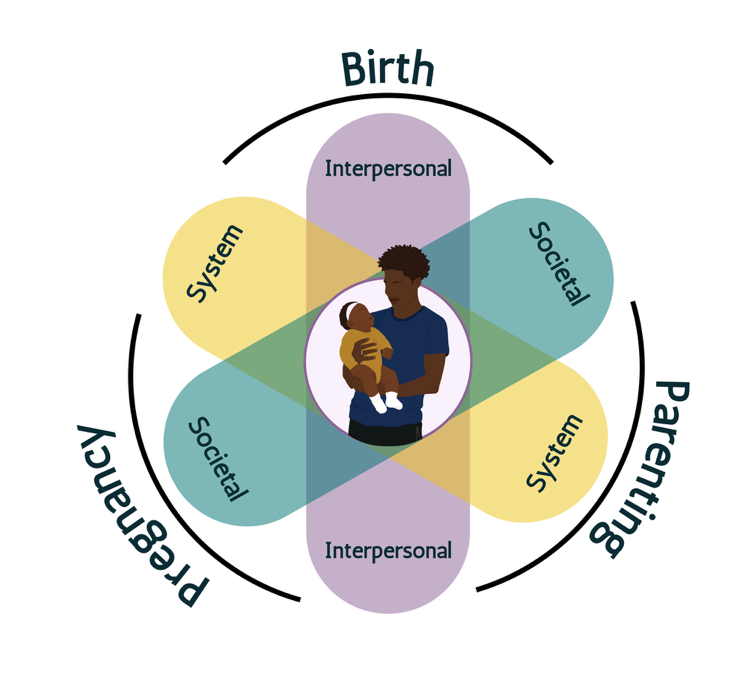
Researchers who study fatherhood illustrate how societal, systemic, interpersonal, and individual factors influence the father’s well-being. This framing acknowledges that people—and fathers—are a reflection of larger communities and systems, which shape their attitudes, decisions, and behaviors.19 Applying this framing is particularly useful when working with and supporting youth in child welfare and/or justice systems. The unique experiences of being involved with these systems and/or experiencing challenges like homelessness inform who young parents interact with, what rules and/or restrictions they must abide by, what kind (and degree) of access to resources they have, and how they view themselves.20 Considering multiple factors also increases understanding of how young children’s well-being and development are impacted by their fathers’ own experiences.21
Below is a visual depiction that reflects the intersection of the four levels (societal, systemic, interpersonal, and individual) and their cumulative influence on young fathers who have experiences in the child welfare and/or juvenile justice systems. At each level, and depending on the age of their child, young fathers may experience unique barriers or facilitators that impact their ability to parent effectively.22,23 In addition, nesting parenthood within the critical stages of adolescence and young adulthood—during which young men are changing developmentally, emotionally, and socially—requires a unique understanding of how the experiences of being an adolescent, transitioning to adulthood, and becoming a father all intersect.24 Youth-supporting professionals should understand and recognize the challenges and opportunities that young fathers experience at all four levels and identify safeguards to help them thrive in their roles as fathers.
Findings
The findings are organized by each of the four levels: societal, systemic, interpersonal, and individual. For each level, we present and synthesize key findings from the available literature, including research gaps and implications for practice.
Societal influences
Negative perceptions of young fathers
Society often views young fathers as uninvolved in their children’s lives, an inaccurate stereotype for many.25 Many youth experiencing the child welfare and/or juvenile justice systems face discrimination and bias, stigma that can be compounded among young fathers involved in one or both systems.26,27,28 Even when they are present in their children’s lives, their performance as fathers is often scrutinized.29,30,31 One study found that young fathers reported higher levels of “felt stigma” (beliefs that others thought that they were a failure or needed too much help) related to young parenthood than young mothers.32
Even though service providers such as social workers may agree that fathers would benefit from a variety of supportive services,33 researchers note a lack of integrated health care, education, or parent skill-building supports for young fathers.34 More specifically, research notes that “beginning in the prenatal period, men often encounter healthcare and insurance policies and practices focused exclusively on mothers and birth outcomes, with minimal attention to the interests and needs of young fathers.”35 Fathers (not young fathers specifically) have reported difficulty navigating the health care system,36 and identifying their role in prenatal care as secondary or supportive to the mother.37 Rather than provide information directly to young fathers, for example, some services may rely on the mother to pass along information;38 those seeking to engage young fathers in research have also relied on young mothers as the access point to young fathers,39 further conveying the perception and narrative that fathers are uninvolved.
Social expectations of fathers
Some young fathers experience a tension between prevailing attitudes around fathering—some of which assert that men should be providers and take responsibility for their children,40,41,42 while others perpetuate perceptions that “most dads aren’t around” (as stated in one qualitative study).43 Traditional societal norms around fatherhood (emphasizing fathers’ roles in providing economic support) may motivate men to pursue higher-earning opportunities,44 but such career changes are not always feasible for young fathers during adolescence and emerging adulthood. In fact, the difficulty of fulfilling the provider role may be a source of significant stress for young men.45,46 At the same time, some young fathers may align more with modern ideals of fatherhood that emphasize warmth and interaction with their children, beyond simply providing economic support.47 The intersection between societal views of fatherhood, young parenthood, and young people in the child welfare or justice systems serves as a foundation for how young fathers experience systems and interact with their providers, families, coparent(s), and child(ren).
Systemic influences
Young fathers who have been involved in the child welfare and/or juvenile justice systems may face challenges that restrict their ability to parent effectively, due to policies and/or the attitudes of youth-supporting professionals with whom they interact. Harty describes the experience of young fathers in foster care as “fathering within the context of a restrictive system,” wherein the level and means of fathers’ involvement with their children are bound by rules imposed by the foster care system, including placement curfews, limits on overnight stays, and approval for out-of-state travel.48 Additional systemic barriers for some fathers include restricted visitation rights or abilities based on their own incarceration, the residential location of their child and/or the child’s mother, whether their child and/or child’s mother are involved in the child welfare system, or assumptions by service providers about fathers’ interest or ability to parent.49,50,51,52
Young fathers involved in the child welfare and/or juvenile justice systems may also interact with one or more additional systems, including human services, education and workforce development, and various health systems. When these systems are supportive and collaborative, they may provide the holistic resources that young fathers need to successfully navigate young parenthood and young adulthood.53,54
Experiences with the human services system as a young father
Human services is a broadly defined field, but it generally refers to the collective of public and community services that aim to help individuals meet their basic needs, improve their overall well-being, and achieve stability in various aspects of their lives.55 Human services (e.g., education and career supports, life skills programming, parenting skills courses) are more likely to effectively support engagement among young fathers when they are multidimensional and contain interventions to accomplish the following:56
- Build self-sufficiency
- Strengthen physical and mental health
- Support housing and financial stability
- Strengthen coparenting and healthy relationship skills
- Share information about laws and policies related to topics that include (but are not limited to) paternity, child support, custody, and visitation
However, supportive services offered for expectant or parenting youth in the child welfare and/or juvenile justice systems—for example, home visiting, visitation, and supervised play—are often focused on (or exclusively oriented around) supporting the young mother.57,58,59
Reluctance to receive human services due to negative experiences
Beyond the scarcity of services focused on fathers’ needs, young fathers with negative experiences in the child welfare and/or juvenile justice systems may be reluctant to engage in programming that does exist. For example, organizations administering Responsible Fatherhood programsa have reported challenges in identifying, engaging, and retaining young fathers. Young fathers entering the program with criminal histories have reported general distrust of programs, a reluctance to participate in services due to negative past experiences with other systems, a fear that information they share about their experiences might be “used against them,” and doubt that programs could understand or meet their specific needs.60
Youth-supporting professionals working in human services should also consider their role in helping young fathers navigate societal factors, including general stigma and discrimination. In an evaluation of Responsible Fatherhood programs, fathers and program staff described ways in which stigma and societal norms informed their interactions with systems, and in turn hindered their ability to coparent.61 For instance, several program staff described how many fathers experienced unaddressed mental health issues and family courts that favored mothers and other caretakers ahead of fathers (e.g., granting custody to a maternal grandparent instead of the father).
Experiences with education and employment systems as a young father
Youth who have been involved with the juvenile justice system commonly experience poorer academic performance, greater frequency of suspension or expulsion from school, and higher likelihood of high school dropout, relative to their peers.62 Due to stigma around any criminal justice system involvement,63 being arrested and convicted before age 26 has been linked with underemployment and lower earnings in young adulthood.64 Youth involved in the child welfare system are less likely than their peers to experience high academic achievement, complete high school, or enroll in and complete postsecondary education.65,66
Low levels of education and high rates of unemployment make it challenging for young fathers to generate income to support their families and be involved in their children’s lives.67 In addition to requiring young fathers to navigate the conditions of probation or parole, a lack of employment has detrimental impacts on their health care coverage and access to stable housing post-incarceration.68 Following incarceration, interruptions to education and employment may further put young fathers at a disadvantage in the workforce.69 These challenges may be even more salient among youth currently or formerly involved in the child welfare and/or juvenile justice systems.
Intersection of employment and child support mandates
Intertwined with poor educational and employment outcomes is the issue of child support. Scant research has investigated how child support expectations and enforcement practices impact young parents involved in the child welfare or criminal justice systems. But research with fathers, more generally, describes fathers’ challenges associated with child support, particularly among those who are unemployed or underemployed or incarcerated. For example, child support and visitation are separate in the legal system, which can be confusing to fathers—especially those without access to adequate legal representation.70,71,72,73 Punitive child support enforcement policies (i.e., being arrested for unpaid child support) may limit young fathers’ involvement with their children—particularly when they are involved in the child welfare system, where their ability to contribute financially tends to be prioritized over other forms of involvement.74
Ways to help young fathers navigate education and employment systems
In our review, we were unable to identify research focused on engaging young fathers who are exiting the child welfare and/or juvenile justice systems in the education and employment systems, which hinders our understanding of their unique experiences navigating these systems. However, research on fathers and fatherhood more broadly offers some insights; for instance, the National Responsible Fatherhood Clearinghouse identified key features of promising programs that may be applicable for providing workforce and education supports:75
- Providing participating fathers and families with incentives to boost engagement
- Incorporating methods and materials into curricula tailored for people with different life experiences
- Adequately training and staffing programs with individuals who believe in the program and its mission/goals
- Using curricula that are targeted and feature clear program objectives
- Using curricula that are based in theory and program elements shown to be effective in other contexts
- Using multiple teaching methods and personalizing information to support fathers on an individual basis
- Having staff who establish one-on-one relationships with fathers
Navigating the health system as a young father
Limited support and engagement of fathers in health care settings
While not focused on young fathers specifically, studies have shown that fathers report experiences of exclusion and lack of father-specific support in health care settings during pregnancy, birth, and the perinatal and parenting stages. A scoping review of 23 studies related to father supports in the perinatal period found that fathers lacked mental health supports after birth.76 Such gaps in mental health service receipt can leave fathers feeling unsupported when trying to navigate paternal postnatal depression.77 Fathers have been found to attend pediatric visits at significantly lower rates than mothers, and clinical guidance suggests using a variety of strategies to engage fathers and provide them with information and support related to parenting.78 In some cases, fathers experienced both active and passive exclusion in family health care settings (e.g., being ignored, experiences of hostility when trying to engage).79 Such experiences, in turn, can lead them to feel unhelpful, pushed away, and invisible.80 In research involving young fathers in foster care, experiences from the prenatal stage through early infancy are mixed.81 Some young fathers report being able to attend medical appointments (e.g., prenatal visits) regularly, whereas others were restricted from being present during their children’s birth by their partners’ parents and did not have caseworkers who would advocate for their rights as fathers.82
Interpersonal influences
A young father does not perform the acts constituting fatherhood in a vacuum, but rather in relationships with others, including their child’s mother, their own parents/caregivers, and their extended family members and other adults—all of which can affect their engagement with their child.
Young fathers’ relationships with coparents
The relationships between coparents have a significant influence on young fathers’ engagement with their partners during pregnancy and with their children after birth.83,84,85,86,87 Interventions specific to strengthening coparenting relationships can positively influence child development and father engagement.88 In one study, incarcerated fathers ages 16 to 19 describe their hope for relationships with their child and partner that help them transform their lives so they can become less engaged in gangs or dangerous behavior and more focused on fathering.89,90
Even when both parents want the father to be involved in a child’s life, relationship conflicts and instability pose threats to fathers’ engagement.91 Reasons for conflict may include fathers’ engagement in risky or criminal activities, poor communication, the end of a romantic relationship, the involvement of multiple partners or coparents, varying or unmet expectations, difficulty managing responsibilities (i.e., financial support, parent-child visitation), or concerns about child safety.92,93,94 However, the presence of a healthy and positive relationship dynamic with the mother can be transformative for a young father, both individually and in relation to their child.95
Youth fathers’ relationships with adult caregivers

Young fathers’ families and other adults in their lives can influence their fathering behaviors.96,97,98 Youth aging out of foster care have reported feeling unsupported by their own families, expressing a desire for material support (e.g., child care), emotional support, and guidance.99,100,101 In one study, incarcerated young fathers reported wanting to do things differently than their own fathers, with researchers concluding that “abusive, neglectful, and absent fathers were described as the cause of many of the participants’ painful childhood experiences.”102 The Children and Family Research Partnership explained that many adolescent fathers grew up without positive relationships with their own fathers and, as a result, strongly desired to be a different kind of father.103 They sought other family members, like uncles or grandparents; peers with children; or social media to learn how to be a more engaged, positive father. Discussions with young fathers revealed their heavy reliance on family members for guidance and support with becoming a new parent, which was mixed for young mothers who reported that involvement from their parents (i.e., grandparents) can be complicated at times.104
Individual influences
At the individual level, young fathers are shaped by their own attitudes and views of fatherhood, their personal life experiences with people and systems, and the fact that they are balancing emerging adulthood and young parenthood.105,106,107 When layered with parenthood, normative adolescent development such as risk-taking, exploring one’s identity, and seeking independence can be challenging for young fathers. Young fathers, like young mothers, may find themselves “growing up” with their young children and learning what it means to be a father by way of mistakes, relationships with others, and influences from society.
Experiences of trauma
Young men with experiences in the child welfare and/or juvenile justice systems often have histories of trauma exposures, either prior to or during their involvement in these systems.108,109,110 In combination with their past life experiences, young men may find it stressful to navigate adolescence and transition into fatherhood. Many young fathers report engaging in substance use and having mental health challenges.111 Like mothers, the birth of a new child can introduce the onset of postpartum depression and anxiety in fathers.112 One study comparing adult and adolescent fathers found late adolescent fatherhood to be associated with less social support and higher frequency of depressive symptoms by the time the child was 3 years old, but dissipated when the child turned age 5.113 Parenting stress was also associated with having been booked and/or charged with a crime by the time the child was 5 years old. These individual factors serve as the backdrop for how young fathers engage with their children, coparents, family members, and service providers. Without applying a trauma-informed lens to their work with young fathers who have systems involvement, youth-serving professionals risk viewing them as apathetic and disconnected.
Personal perceptions of fatherhood
As reflected in research about interpersonal influences, service providers and youth have expressed that a lack of healthy examples of fatherhood define young fathers’ views of fatherhood and father identity.114,115 In some studies, young fathers reported knowing what fatherhood wasn’t but were not confident about what it was (i.e., what was required to be a good father), due to their own traumatic and abusive childhood experiences.116 Additionally, incarceration or justice system involvement creates extended periods of separation from children, which can introduce insecurities and fears around being a proactive father.117 Despite these challenges, young fathers report enthusiasm and embrace the idea of being good fathers.118
Informed by societal views of fatherhood, young men in the foster care or juvenile justice systems tie their primary roles as fathers to being a provider119 or to an idealized view of manhood.120 The expectation of being a provider was closely tied to ideals about masculinity and the anticipation of needing to fill the role of protector for their children.121 Qualitative research focused on adolescent fathers involved in the justice system has identified young men’s preference for parenting sons over daughters because it represents an opportunity to “make their son a man” and encourage their sons to avoid activities that can lead to criminal justice system involvement.122 These personal perspectives shape young men’s identities as fathers and inform their decisions and behaviors when engaging with their children, navigating the relationships with the child’s mother, and engaging with different systems.
Conclusion
Based on the available literature, youth-supporting professionals have multiple opportunities to support young fathers, both individually and in relation to their children—and across levels. Especially at the systemic and interpersonal levels, youth-supporting professionals can help alleviate challenges in accessing needed services, advocate for young fathers to be actively engaged in services, and foster healthy relationships between fathers and their children, coparents, and others. By understanding the multiple factors that inform young fatherhood, these professionals can apply a multi-pronged approach to working with young fathers, who must already navigate complex systems in child welfare and juvenile justice.
Footnotes
- Responsible Fatherhood is a federally funded program for fathers ages 18 and older with children ages 24 and younger, providing comprehensive healthy relationship and marriage education services, as well as job and career advancement activities to advance economic stability and overall family well-being. As part of the program’s routine efforts, it supports fathers with histories in child welfare and juvenile justice involvement. ↩