Purpose
A wealth of research literature describes healthy romantic relationships among adults and youth, broadly, but there is more limited research about healthy romantic relationships among young people who experience the child welfare and/or justice systems, homelessness, and/or disconnection from school and work (i.e., opportunity youth). Most of the available research focuses on youth in foster care and building healthy relationships with their families of origin, foster parents, or peers. Similarly, several practice resources, such as program curricula, describe the importance of healthy romantic relationships among youth. Few of these practice resources include cultural considerations, tools, and actionable techniques for helping young people at greater risk for negative relationship experiences communicate effectively, build and set boundaries, and establish shared power within romantic relationships. Gaps in the research literature—and, therefore, in research-based practice resources—about healthy romantic relationships among youth who experience the child welfare and/or justice systems, homelessness, and/or disconnection from school and work limit youth-supporting professionals’ capacity to address risk for entering or being in unhealthy relationships among youths with these experiences.
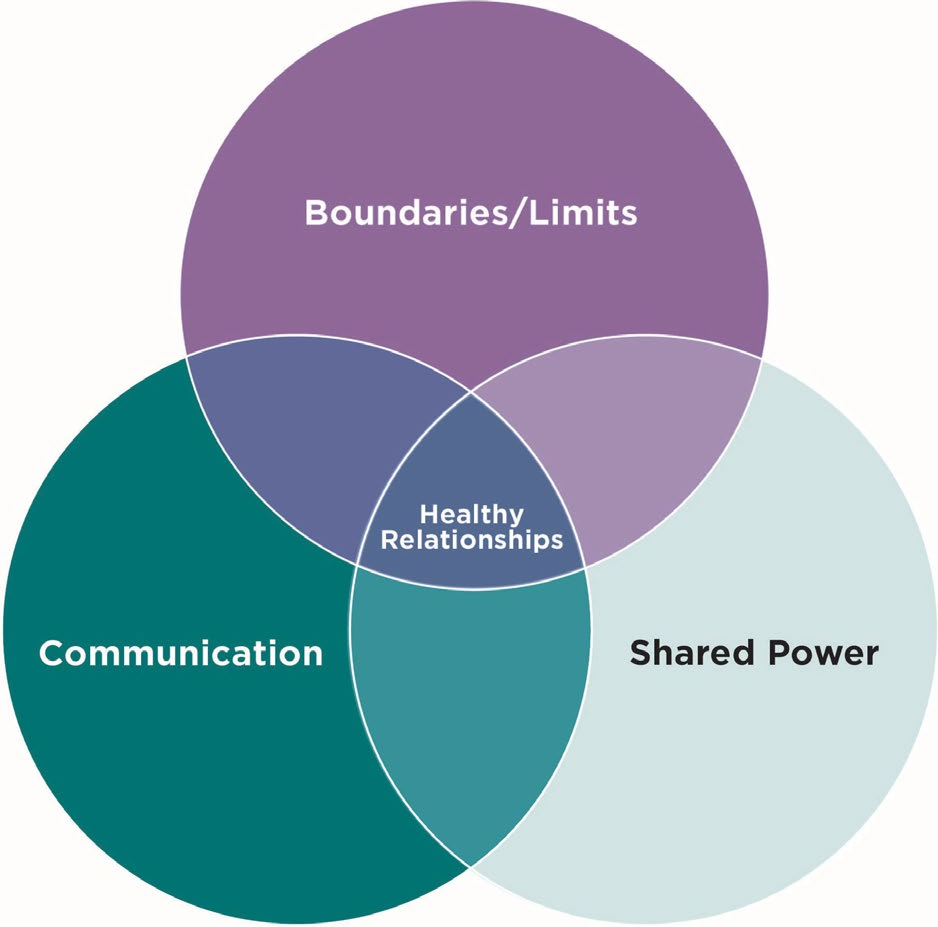
This resource summarizes research and practice literature, provides practice guidance, and describes cultural considerations (i.e., recognizing the beliefs, traditions, values, and ways of life that influence how people communicate, make decisions, and relate to one another) and other contextual factors associated with three key domains of healthy romantic relationships:
- Communication
- Boundaries/limits
- Shared power
Overview
Most research about romantic relationships involving young people who experience the child welfare and/or justice systems, homelessness, and/or disconnection from school and work focuses on preventing and recognizing the signs of unhealthy romantic relationships. Youth with these experiences are at higher risk for being in unhealthy romantic relationships and experiencing physical or sexual abuse—relative to young people without these experiences—due to certain risk factors, such as:
- A lack of experience observing and experiencing healthy relationships1–3
- Risk of instability generally (e.g., housing, school), which may create instability in relationships4
- Experiences with trauma associated with systems-involvement, homelessness, or disconnection5–7
Youth-supporting professionals should know how to help young people who experience the child welfare and/or justice systems, homelessness, and/or disconnection from school and work form, recognize, and understand healthy romantic relationships and be able to help them leave an unhealthy romantic relationship. Engaging in romantic relationships is developmentally appropriate during young adulthood: 35 percent of adolescents ages 13 to 178 (and almost all youth by age 18) report having dated at some point.9 Helping young people have healthy relationships may have lasting impacts. Healthy romantic relationships during adolescence and emerging adulthood are shown to be associated with more positive well-being outcomes (e.g., fewer mental health concerns, higher life satisfaction, higher self-esteem).10 These well-being outcomes are associated with other positive young adult outcomes such as academic success.11,12
A review of research and practice literature confirms that a broad array of domains are important indicators of healthy romantic relationships.a Therefore, we gathered input from a group of advisors (comprised of youth, youth-supporting professionals, program administrators, and researchers) to identify a select set of domains critical for young people who experience the child welfare and/or justice systems, homelessness, and/or disconnection from school and work. Critical domains we identified include:
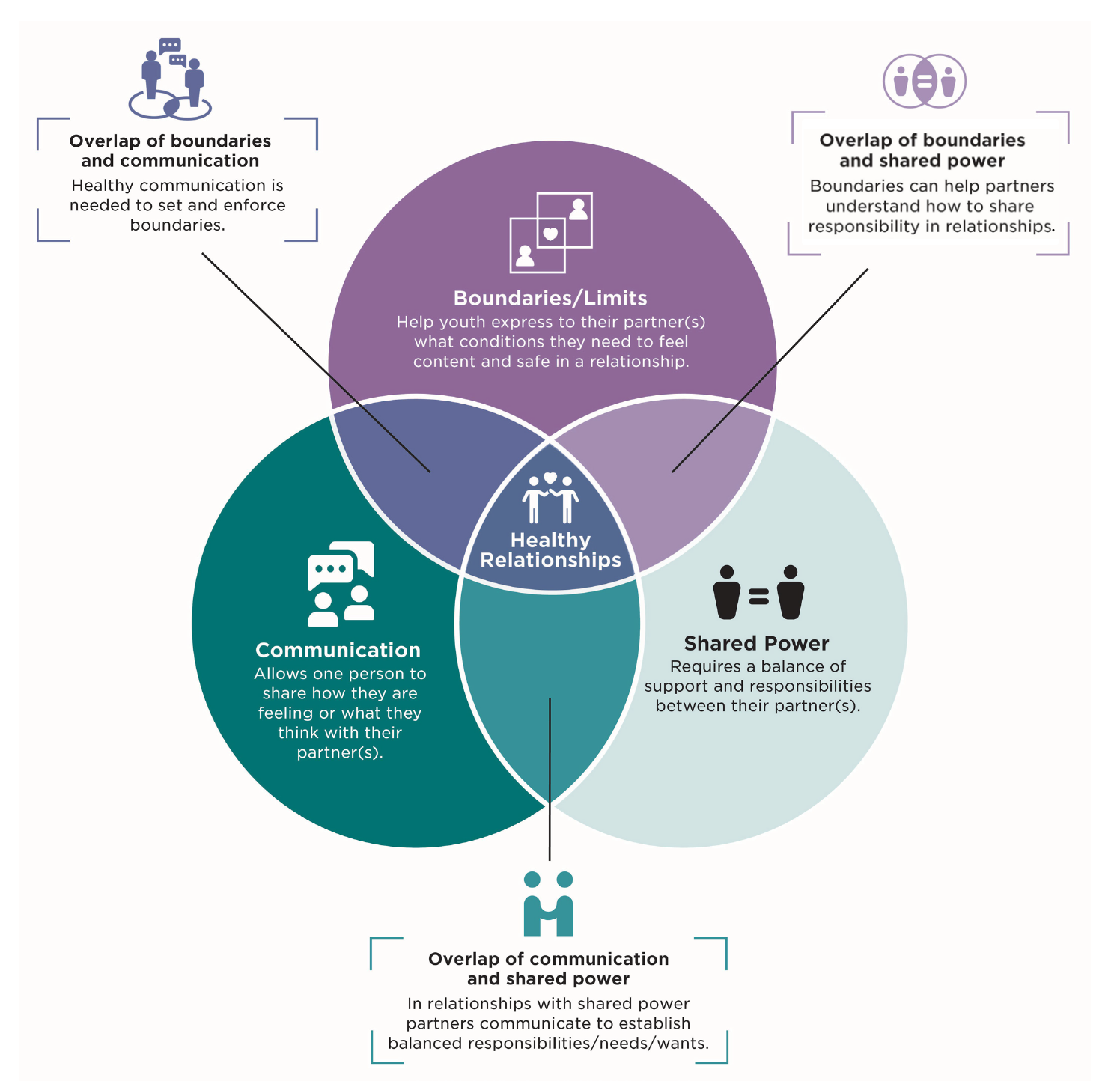
- Communication, which involves active listening, honesty, and nonverbal communication. Communication allows one person to share how they are feeling or what they think with another.13
- Boundaries/limits, which helps youth express to their partners what conditions they need to feel content and safe in a relationship.14
- Shared power, which requires a balance of support and responsibilities.15 Shared power can include an agreed-upon provision of support, a sense of fairness, and mutual respect.16
These domains overlap and are all needed to foster healthy relationships.17 For example, mutual respect is needed for a person to feel comfortable communicating their boundaries and enforcing those limits.
Culture and other considerations also impact how a relationship is structured and, as a result, there may be variation in the ways these domains are observed and experienced. For example, societal or cultural differences in how relationship norms influence youths’ view of roles within a relationship, or norms that are specific to a geographic location. Other contextual factors can also influence relationship expectations among young people who experience the child welfare and/or justice systems, homelessness, and/or disconnection from school and work, and the professionals that support them. Within the discussion of each domain (communication, boundaries/limits, and shared power), we describe research and research-based examples of related cultural and other considerations.
Findings
For each healthy romantic relationship domain listed below, we provide a summary of the research and research-based resources on the topic, cultural considerations related to the topic, and a list of research-informed practice tips for supporting youth.
Findings Note
The information about communication discussed here is important, regardless of whether the communication occurs in-person or electronically. Electronic communication through text messages, social media, email, and dating apps has broadened the considerations that youth-supporting professionals may need to make when working with youth on healthy communication skills. For example, 53 percent of young adults ages 18–29, and 8 percent of teens ages 13–17 reported online dating. Among all youth ages 13–17, 57 percent started a friendship in a digital space.a While online communication can expand a young person’s network, it also introduces additional risk. Estimates of cyberbullying among adolescents ages 12–18 range from 10 percent to 70 percent. There is a gap in research on the prevalence of cyberbullying specifically about dating and within relationships.
a Pew Research Center (2023). The who, where, and why of online dating in the US. ↩
Communication
Youth consistently report that healthy communication is a core relationship value. Communication allows one person to explain what they are experiencing—or what they need—to their partner.18 Research finds that healthy communication between romantic partners has a significant impact on individual well-being and relationship quality and satisfaction for young adults.19–21 For young parents, communication between co-parents also affects their children’s well-being, academic achievement, social skills, and stress levels.22 Studies also suggest that youth often struggle to communicate with romantic partners and may lack confidence in their own communication skills.23 These challenges may be magnified for young people who experience the child welfare and/or justice systems, homelessness, and/or disconnection from school and work due to their decreased access to and consistent connections with trusted adults or peers who can help them problem solve and limited opportunities to safely practice open and honest communication.24–26 However, most of the healthy relationship research and practice resources on healthy communication with partners do not address the unique needs of youth with these experiences.
Healthy communication can allow partners to handle stressful situations, manage conflict, apologize when needed, help ensure everyone in the relationship is on the same page, and establish a strong sense of understanding and connection.27 Components of healthy communication include active listening, honesty, and being aware of non-verbal communication.
Healthy communication requires youth to be able to express themselves, regulate their emotions, and have a sense of self-awareness.28,29 Communication is a precursor for other components of healthy relationships such as setting and enforcing boundaries and addressing power dynamics, which are discussed in the next section.30–32
Considerations to help youth build communication skills
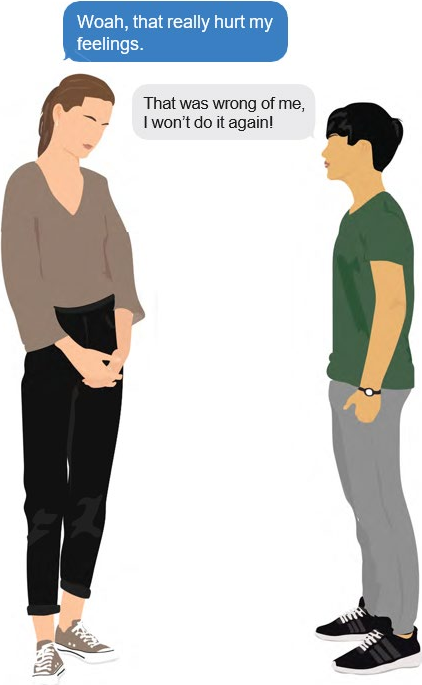
Communication styles and preferences may differ among cultures and therefore influence intercultural relationships. For example, young people may vary in the ways they communicate depending on the cultures they experience and those cultures’ use of high and low-context communication. High-context communication relies on heavy use of implicit information like body language, eye contact, and tone of voice. Low-context communication norms include using explicit information like words and facts.33,34 These differences might lead to miscommunication in partners if one partner uses nonverbal cues and another partner is unaware of those cues.35 Additionally, different communication styles may not be appropriate for every relationship. For example, a more assertive communication approach, especially for women, may not align with the values and communication patterns within some cultures.36 Young people who experience the child welfare and/or justice systems, homelessness, and/or disconnection from school and work may need to adapt their communication style to maintain safety in a relationship.37 For example, an assertive communication approach may not be effective if it increases the likelihood of a negative or violent response from a partner. Youth-supporting professionals should be aware of differences in communication that are shaped by a particular partner, and help youth navigate these differences within their relationships.
How to help youth build communication skills to foster healthy romantic relationships
When helping young people who experience the child welfare and/or justice systems, homelessness, and/or disconnection from school and work build communication skills to foster healthy relationships, youth-supporting professionals should:
- Model healthy communication and problem-solving skills.38,39
- Help youth practice communicating in healthy and productive ways (e.g., considering emotional expression, tone).40
- Encourage youth to reflect on past relationship conflicts or communication breakdowns and develop standards for healthy communication based on their experiences.41
- Acknowledge that more youth than ever are relying on online communication to either identify potential partners (e.g., online dating)42 or communicate with partners (e.g., direct messages on social media).43 Encourage youth to consider their romantic and sexual communication online and develop norms for using social media, dating apps, and engaging in sexting.44 This may involve creating boundaries for online communication and practicing saying “no”45 to a request that violates those boundaries.
- Encourage youth to think about how they communicate consent, develop an understanding of how they will demonstrate affirmative consent, and give them the tools to have ongoing conversations about consent.46 Consent is a central component of any healthy relationship and effective communication is an important part of establishing initial consent and continuing to discuss consent throughout a relationship.
- Encourage youth to take initiative and start hard conversations when needed.47
- Work with youth in a way that is nonjudgmental and supportive when they are describing their experiences.48
- Encourage youth to establish boundaries and norms around communication expectations with partners.49
- Work with youth to hear and listen to what the other person is saying.50
Boundaries/limits
Studies show that healthy relationship programming for adolescents generally improves their ability to differentiate between characteristics of healthy and unhealthy relationships, and to recognize the important role of boundaries.51–53 In romantic relationships, boundaries constitute individuals’ expectations and limits of what behaviors are acceptable or not acceptable of themselves and their partners. Boundaries help youth express to their partners what they need to feel content and safe in a relationship and help their partners understand how they can support the relationship.54,55 Setting effective boundaries requires youth to express their own needs and limits and be open to listing and respecting boundaries set by their partners.
Boundaries can take many forms, but most sources identify four main categories: physical, material, mental/intellectual, and emotional.56
- Physical boundaries are an individual’s boundaries related to their body, which include sexual boundaries. These boundaries include the kind and level of touch they find acceptable, as well as how and when they are comfortable sharing space. Examples of physical boundaries include the amount of physical space a person wants in private and in public, whether they feel comfortable with affection in public, and whether they prefer spending time alone.57
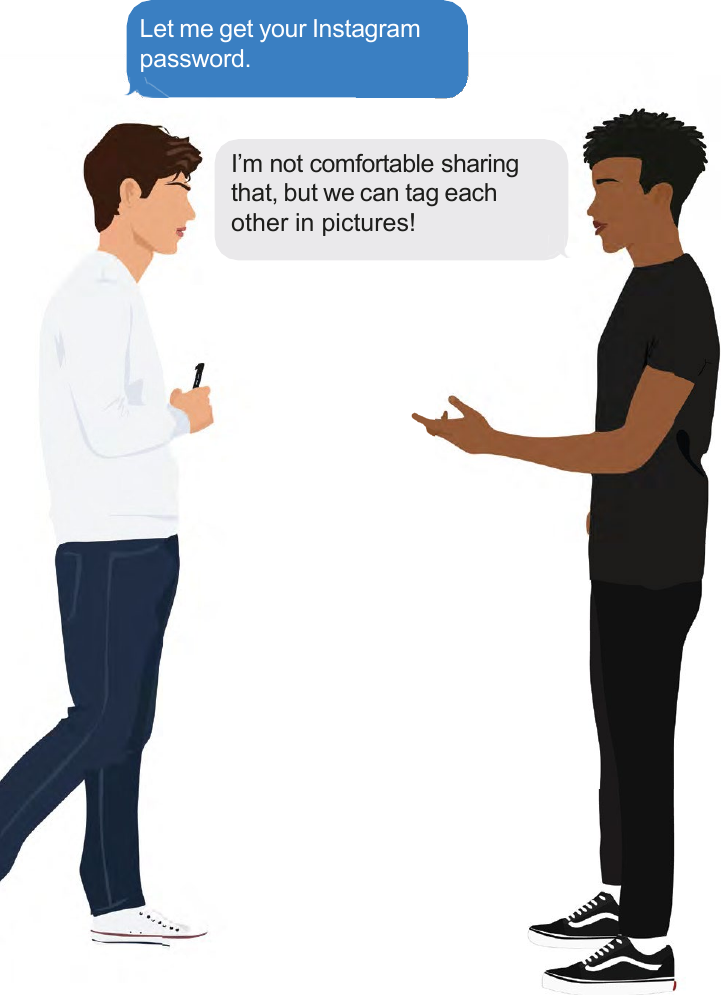
- Material boundaries are an individual’s boundaries regarding their resources and belongings. They include whether and to what extent an individual is comfortable sharing or loaning things like money, clothing, vehicles, or cell phones.58
- Mental or intellectual boundaries are an individual’s boundaries about values, opinions, and beliefs. Individuals have different sets of values and beliefs that serve as guiding principles behind their decisions, actions toward others, and understandings of the world.59 Mental boundaries may include values that an individual feels are especially important, such as trust and honesty.60 Individuals may also set boundaries related to political beliefs.
- Emotional boundaries are boundaries related to someone’s emotions and include boundaries about when and what personal information they share.61 For example, an individual may be comfortable sharing impactful or traumatic experiences from childhood, or they may prefer to maintain their privacy.62 Similarly, an individual may be comfortable or uncomfortable with others sharing highly emotional and detailed experiences with them.63
Boundaries are rooted in what individuals find comfortable or uncomfortable and are highly individualistic: Everyone has different boundaries based on their experiences in life and relationships, both romantic and nonromantic.64 Young people who experience the child welfare and/or justice systems, homelessness, and/or disconnection from school and work may not have the information or skills to set appropriate boundaries.65–67 Healthy relationship curricula and programs have been shown to help youth understand the importance of boundaries and establish limits that support their own needs. For example, a recent evaluation of a healthy relationship workshop found that “vulnerable youth” who attended the workshop had an increased ability to identify unhealthy relationship characteristics and to set and enforce boundaries.68 In addition, the curriculum helped vulnerable youth practice saying “no” and clarified for youth that it may feel selfish to establish boundaries, but that it is necessary to assess and address one’s needs.
The research and practice resources cite communication69–71 as the most effective strategy to establish boundaries. Strategies can include partners asking each other clear questions about what they are/are not comfortable with (e.g., “Are you okay when…?” and “Are there things you aren’t comfortable with when…?”), not making assumptions about partners, and not pushing one’s views onto partners. As with recommendations on setting boundaries, however, resources on healthy relationships recommend holding others accountable by clearly communicating when a boundary is crossed, the consequences for crossing a boundary, and following through on that consequence.72 Relationships may be unhealthy if a young person’s boundaries are ignored, minimized, or disrespected by a partner.73
Considerations for setting and enforcing boundaries in healthy romantic relationships
Norms associated with boundary-setting vary across contexts. For decades, research has explored how growing up in either collectivist or individualist societies impacts one’s expectations of themselves, their partners, and others (e.g., parents, caregivers, family members, friends) in romantic relationships.74,75
For example, how an individual grew up may influence their understanding and preferences related to autonomy or interdependence.76 If one partner grew up in a collectivist culture, they may expect to spend most of their time with their partner and do things together, whereas someone who grew up in an individualist culture may want more autonomy and independence in a relationship.77 Youth-supporting professionals should work with youth to understand the different ways in which culture influences relationships and how to navigate differences with their partner.
Furthermore, young people who experience the child welfare and/or justice systems, homelessness, and/or disconnection from school and work may experience additional barriers to setting boundaries due to their experiences and may feel powerless or blamed for not having boundaries.78–80 Therefore, youth-supporting professionals should not blame or judge them for a lack of boundaries and should instead focus on empowering them to work toward establishing boundaries for future relationships.
How to help youth set and reinforce boundaries in healthy romantic relationships
Research and practice tools indicate that youth-supporting professionals helping young people who experience the child welfare and/or justice systems, homelessness, and/or disconnection from school and work set and enforce boundaries should consider encouraging youth to:
- Explore answers to questions about their physical, material, mental, and emotional boundaries, such as:81
- “Would I be okay with physical touch when I’m not expecting it?” or “What kind of physical touch or intimacy am I comfortable with in this situation/with this person?”
- “Is it okay if my partner uses my phone?”
- “Do I want to share social media passwords?”
- Reflect on past experiences when they did set boundaries or wished they had set boundaries.82
- Check in with their partner often on whether boundaries are being respected and upheld, rather than assume how their partners feel.83
- Consider how to respond if a partner violates one of their boundaries.84
- Take responsibility for crossing boundaries when/if that occurs.85
Shared power
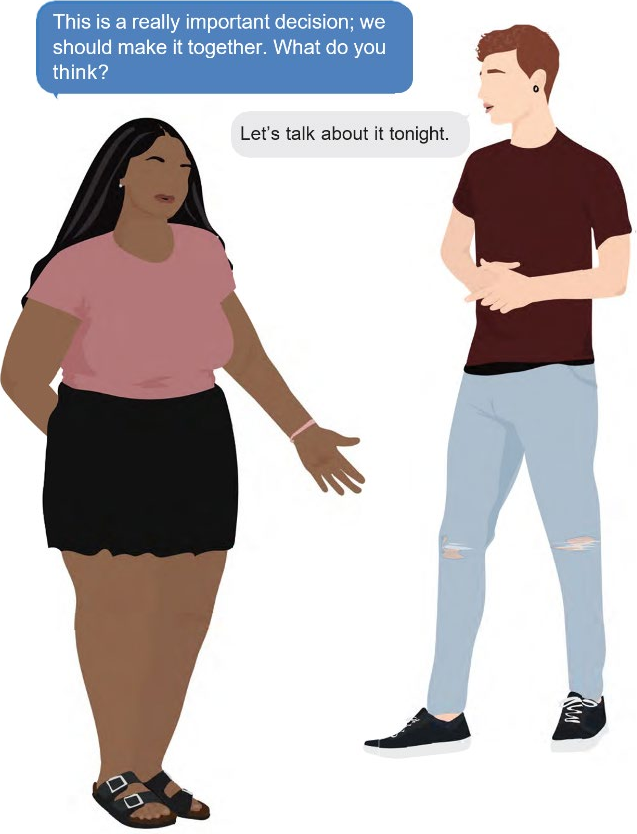
Healthy relationships require a balance between partners—in this context, reciprocal and shared power, including support, respect, and personal agency. Shared power in relationships helps prevent negative relationship outcomes such as dating violence86,87 and is a focal topic among several relationship interventions.88,89
Elements of shared power within relationships include a mutually agreed upon provision of support between partners, a sense of fairness, and mutual respect.90,91 Research on the skills that promote healthy romantic functioning in young adults found that those who demonstrated more mutuality—or consideration of the needs of others as well as one’s own needs—tended to feel more secure and satisfied in their relationships.92 One study found that adolescents in relationships characterized by more supportive interactions with their partners exhibited better mental health nearly a decade later.93 Lower satisfaction with the division of decision making in a relationship is a risk factor for negative relationship outcomes, including victimization by one’s partner.94
Existing differences in life and relationship experience can create power dynamics that challenge shared power in relationships. Many youth experience a real or perceived disadvantage to their power within a romantic relationship. These power dynamics may include situations where partners have 1) a large gap in age or experience in romantic relationships;95 2) differences in wealth, income, or the stability of their living situation;96 and 3) differences in social networks and support.97 Such power imbalances can make one partner susceptible to unhealthy relationship dynamics such as unhappiness and lower trust,98 increased sexual risk behaviors,99 or even threats to their well-being (e.g., dating violence).100 Such power differences do not exist in isolation; in fact, multiple power dynamics may compound to tilt the balance more strongly toward one partner.
Considerations to help youth enhance shared power in healthy romantic relationships
Romantic relationships exist in the context of social and cultural norms. For example, adolescents may face pressure to fill certain relationship roles.101 Current research indicates that when adolescents hold more balanced beliefs about male and female roles in relationships, they endorse fewer harmful myths about romantic relationships, experience less hostility and violence, and have higher overall relationship quality.102
How to support youth and foster shared power in healthy romantic relationships
For adolescents and young adults, romantic relationships that are mutually supportive and balanced across partners are more secure and rewarding103 and have better implications for youths’ well-being.104,105 However, discussing power in relationships may be a difficult subject. Adolescents may feel self-conscious or defensive about an unequal or power-imbalanced relationship they are in. Youth-supporting professionals may want to avoid stating or implying that a young person who experiences the child welfare and/or justice systems, homelessness, and/or disconnection from school and work is on the receiving (or benefiting) end of a power imbalance.
Instead, consider asking guiding questions such as:b
- In what ways do you support your partners? How does your partner support you?
- Do you and your partner feel safe to express your needs and wants?
- Are you happy with how balanced your relationship feels?
Based on this research and existing evidence-based practice tools on healthy relationships identified in this summary, youth-supporting professionals may need additional tools for working with young people who experience the child welfare and/or justice systems, homelessness, and/or disconnection from school and work. The tips for working with youth presented here are a starting point for these conversations.
Footnotes
- Based on the results of the literature review, communication, boundaries/limits, and shared power were often cited as critical to healthy relationships and encompassing of other relationship domains (e.g., healthy communication requires honesty and openness). Activate advisors ranked these three domains as the most discussed with youth and in need of additional resources. For more information, see the methodology section at the end of the document. ↩
- These are informed by a body of literature but are not attributed to a specific source. Rather, based on all research reviewed, the authors developed these guiding questions. ↩