Introduction
Consent for sexual activity (hereafter referred to as consent) is the foundation for safe and respectful sexual activity. Consent is defined as voluntary, informed, and mutual agreement among those involved in sexual activity, conveyed through clear words or actions by individuals who are fully ablea to make such a decision.1,2 Research highlights that consent is an active, ongoing process that includes both the freedom to agree and the right to decline. This process has three interconnected processes:
- Giving consent—communicating one’s willingness to engage in sexual behavior. Giving consent also includes communicating that one does not want to engage in sexual behavior.3
- Seeking consent—inquiring about whether one agrees to sexual behavior or learning the partner(s) does not agree, through verbal or nonverbal signs.4
- Receiving consent—the process through which an individual interprets whether they have received consent from another person and acts accordingly.5,6
Throughout this summary, we refer to consent as agreement to engage in sexual activity. We also address the equally important decision to decline to engage in sexual activity.
Through a needs assessment about information and practice tools focused on sexual and reproductive health, youth-supporting professionals identified consent for sexual activity as a topic for which they need more knowledge to strengthen their work with young people. To address this gap, this resource summarizes research about forms of consent; communicating consent; seeking, giving, and receiving consent; and factors influencing consent behaviors among youth—both broadly and among youth experiencing the child welfare and/or juvenile justice systems, homelessness, and/or opportunity youth (i.e., disconnected from school and work). Professionals can use this summary to enhance their awareness about the components of consent and inform their work to support youth programs and young people.
There is limited research about consent focused on young people who experience the child welfare and/or justice system, homelessness, and/or disconnection from school and work. Therefore, we summarize research about consent from more general populations, which tends to focus on college-enrolled young people. We also include research about consent among young people who experience trauma and adversity. Young people who experience the child welfare and/or juvenile justice systems, homelessness, and/or disconnection from school and work experience a greater prevalence of trauma and adversities associated with sexual and reproductive health.7,8,9,10 In addition, the research about consent is informed by diverse perspectives. The literature we describe is peer-reviewed, and our search focused on key words about consent such as sexual consent education, consent for sexual activity, consent education, consent communication, sexual consent, teaching consent, and comprehensive sex*ed.
Key findings
- Young people who experience the child welfare and/or juvenile justice systems, homelessness, and/or opportunity youth are more likely to experience trauma. Youth-supporting professionals say they need trauma-informed resources to hold successful conversations about consent with young people.
- There are many definitions of consent. No definitions are universally accepted, but many have common attributes. Consenting individuals must be fully informed about the activity for which they are consenting and their potential partners’ sexual health. Consenting individuals cannot be coerced and are able to give and revoke consent at any time.
- Sexual partners can communicate consent in many ways. Regardless of how they communicate consent, all parties must be clear about the agreement, or lack thereof, and respect that decision.
- Youths’ histories and experiences (e.g., age, disability) may influence how they seek, give, and receive consent for sex.
- Context (e.g., substance use, social norms, relational factors) can influence consent behaviors and communications.
Why It’s Important to Talk About Consent
Many—although not all—youth engage in sexual activity.11 In 2023, 32 percent of high school students reported ever having had sex.12 Studies of youth who experience the child welfare and/or justice system or homelessness generally find higher rates of sexual activity. Among youth in foster care, estimates range from 40–50 percent of youth who report ever having had sex by age 18.13,14 Among high schoolers experiencing housing instability, 48 percent reported being currently sexually active.15 Among young women in short-term juvenile justice facilities, up to 76 percent reported ever being sexually active.16
Sexual development is a normal part of adolescence. Youth begin to experience changes in their sexual development at puberty17 and the median age of first intercourse for young people is 17 years.18,19 However, social, psychological, developmental, and other factors may influence if and when individual youth engage in sexual activity.20 Regardless of whether or not youth engage in sexual activity, they may find themselves increasingly in situations in which sexual activity is occurring or in which they must understand how to say no and decline to participate in sexual activity—and how to provide consent. Therefore, teaching about consent is developmentally appropriate for youth and ensures that they have knowledge to decline to engage in sexual activity until they are ready and, when they are ready, to engage in sexual activity safely.21
For example, when youth wait to have sex until their late teens, they report higher rates of contraception use and experience lower rates of contracting sexually transmitted infections (STIs).22 The lower risk for STIs is due, in part, to improved decision making and increased communication skills about consent and other aspects of sexual activity.23 In addition, increasing knowledge of consent and the importance of receiving consent before moving forward with sexual activity might help prevent some forms of sexual violence.24 However, effective sexual violence prevention programs must incorporate several elements, of which consent is just one. Consent alone is not enough to prevent most forms of sexual violence and only focusing on consent may inadvertently oversimplify sexual violence and blame those who have experienced sexual violence.25
Regardless of when (or if) youth become sexually active, there are several skills that can help them make consent-related decisions.26 Youth with strong emotional regulation27,28 and self-efficacy29 may be more comfortable during the decision-making process and more capable of communicating their decision with potential partners. Conversely, experiences of trauma may challenge youths’ ability to provide consent and have unique implications for how youth seek, give, and perceive consent.30,31 Disproportionately high rates of youth who experience the child welfare and/or juvenile justice systems, homelessness, and/or disconnection from school and work experience traumatic events and residual trauma-related symptoms and behaviors.32,33 Therefore, a trauma-informed lens can generally support young people with these experiences while also building on their unique strengths.
Consent is an active, ongoing process, with both internal and external components influencing whether one provides consent for sexual activity or declines sexual activity. Consent can be reversed at any time, and agreement to sexual activity at one point in time does not imply an indefinite agreement (consent) for sexual activity.
Willis, M., & Jozkowski, K. N. (2019). Sexual precedent’s effect on sexual consent communication. Archives of Sexual Behavior, 48, 1723-1734. https://doi.org/10.1007/s10508-018-1348-7
Young people experiencing the child welfare and/or juvenile justice systems, homelessness, and/or disconnection from school and work may miss critical information about consent when schools are the primary setting for addressing the topic of consent—whether through sex education, sexual violence prevention education, or healthy relationship education—as many experience instability in school settings,34,35 frequent changes in placement/living arrangements,36 and a lack of consistent relationships with supportive adults.37,38 Further, foster caregivers, caseworkers, and other supportive adults report not being equipped to talk with youth about sex education or report that they don’t see it as part of their duties.39 Yet for young people in the child welfare system, caseworkers are often a primary source of information about sex education.40 Additionally, research about professionals who support youth who experience the juvenile justice system finds that these professionals report several barriers to providing access to sexual and reproductive health resources, including laws that limit what can be taught, the absence of laws requiring anything to be taught, a lack of access to appropriate information, and personal views that influence what one is willing or able to talk about with youth.41
In a scan of the literature describing sex education curricula designed specifically for youth experiencing the child welfare and/or juvenile justice systems, homelessness, or disconnection from school and work, we identified eight research- and evidence-based curricula that might help youth-supporting professionals talk with youth about consent (see the appendix for more information about curricula). The curricula provide youth-supporting professionals with skills to talk with youth about consent and other communication skills related to sexual activity. Education about consent and communication related to sexual activity is critical, as youth who feel more informed about sex are more likely to view asking for and receiving consent as important.42 Of the eight curricula, two (Thrive and Teen Talk Foster Youth) directly discuss consent, while another three discuss communication skills related to sexual activity but do not specify whether consent is covered in the communication skills taught. Although the curricula are evidence-based, none of the studies directly evaluate whether the components on consent are directly linked to positive outcomes such as decrease in sexual violence, increase in trust in the relationship, increased comfort in negotiating consent, or increased knowledge of seeking and receiving consent.
Definition of Consent
Consent is defined in many ways. We use a combination of legal and practical definitions to define consent. As stated earlier, consent is defined as a voluntary, informed agreement among those involved to engage in sexual activity, conveyed through clear words or actions by individuals who are fully ableb to make this decision.43,44 Given that we describe consent as a decision reflecting agreement to engage in sexual activity, we also include the decision to decline to engage in sexual activity throughout the brief. Both decisions are equally important.
Forms of consent
The definition of consent includes three forms of consent: external, internal, and legal. External consent involves clear communication about whether one agrees to engage in sexual activity.45 Additionally, young people may decide to decline to engage in sexual activity and communicate that decision with their partners, both verbally and nonverbally. Internal consent is the way one feels and thinks about their affirmative decision to engage in sexual activity, which requires reflecting on one’s feelings, values, comfort levels, and beliefs.46,47 Young people may also decline to engage in sexual activity if they think or feel negatively about engaging in sexual activity. Internal consent requires youth to explore their own feelings and recognize that those feelings are highly contextual and may change in different situations.48
Consent requires sexual partners to perceive and comprehend decisions of whether to engage in a particular activity at a particular time (i.e., receiving consent).49 Partners may communicate and perceive external consent using both verbal and clear, voluntary nonverbal cues. An example of verbal consent is providing an enthusiastic, verbal “yes” to a partner.50,51 Verbal responses can also be combined with clear, voluntary nonverbal cues (e.g., saying “yes” while also leaning into another person or saying “no” while pulling away). Research shows that, when giving consent that relies on verbal communication and when seeking consent, verbal clarifications are the best way to reduce ambiguity.52 Young people who have experienced traumatic events may not show the same level of assertiveness in refusing unwanted sex,53 indicating that youth-supporting professionals may need to talk with youth about how to be assertive in saying “yes” or “no” and how to manage and respond to receiving a no or lack of consent from a prospective partner. Further, youth who have experienced trauma may face additional barriers to communicating their external consent in a way that matches their internal consent. For example, feeling pressured to please a partner, regardless of one’s own desires, is a common response for those with a history of childhood sexual abuse.54 Further, some survivors of sexual violence report reduced interest in sex, not feeling comfortable in their bodies, and experiencing anxiety or panic during sexual activities.55,56 Some survivors of sexual violence may avoid intimacy or experience a disconnect between their internal consent and what they express verbally.57
Young people must respect verbal and nonverbal consent during all sexual activity. Further, any indication that a potential partner does not want to engage in sexual activity requires everyone to pause, clarify whether the activity should proceed, and then stop if needed.58 Consent can be complex when internal and external consent do not align. For example, a young person’s outward communication (e.g., saying “yes” or “no”) may not align with their internal feelings due to factors such as coercion, aggression, or stereotypes and norms.59,60 If a young person verbally agrees but hesitates or seems unsure, it is their partner’s responsibility to get clarification about whether consent was provided.61 Acknowledging the complexities and nuances of consent is not a validation of harmful myths (e.g., “they said no but really mean yes”). Rather, these complexities highlight why many consent education frameworks (“yes means yes”) oversimplify the consent process and may fail youth who experience barriers (e.g., coercion, intimidation) to declining to engage in sexual activity safely.62
Legal consent
Legal definitions of consent often focus on external consent—what is communicated (or not) to the other parties and each partner’s ability (or not) to consent. Legal definitions are typically based on factors like age and scenarios such as being asleep or unconscious and/or being intoxicated (either voluntarily or involuntarily) to the point of incapacitation, partial consciousness, or lacking of awareness of one’s surroundings.63 Importantly, any form of sexual activity that occurs without the consent of all partners is considered a form of sexual violence,64 with consequences and legal ramifications varying across states, ages, and types of sexual activity (e.g., statutory rape, rape, unwanted kissing).65
Youth-supporting professionals should be aware of their states’ mandatory reporting requirements, which legally require them to report disclosures from youth under age 18. For example, in some states, professionals are obligated to report if a youth discloses any sexual activity with an adult, even if the youth describes the activity as consensual. Further, in some states, reporting may be required depending on the youth’s age (e.g., age 13 and under) or if their partner is more than three years older than them (e.g., ages 14 and 17). Most states require reporting any sexual activity described as coercive or unwanted, regardless of the age of the person(s) involved. See the Complexities and Caveats section below for more information.c
There is considerable variation in states’ legal definitions of consent, how the definitions account for internal consent, and what constitutes coercive behavior in seeking and receiving consent.66 Additionally, legal definitions of consent may not account for scenarios that are unique to youth experiencing the child welfare and/or juvenile justice systems, homelessness, or disconnection from school and work. For example, youth who experience the child welfare system have high rates of lifetime sexual abuse (estimates range up to 27%).67 These experiences of trauma can affect how youth respond in sexual scenarios involving seeking, giving, and receiving consent.68 Legal definitions may not address the nuance of consent—or what happens internally before a young person communicates how they are feeling.
Communicating Consent
Effective consent communication involves both giving consent and receiving consent—or understanding that another person is consenting (or not) to sexual activity.69 As described throughout this summary, part of communicating consent can also include the opposite of consent—that is, declining to engage in sexual activity.70 Young people often use a combination of verbal and nonverbal indicators of consent.71,72 Research on consent stresses the importance of seeking, giving, and receiving an active and explicit agreement (e.g., “yes”) before engaging in sexual activity.73,74 The research also stresses the importance of youth feeling empowered to say “no” and declining to engage in sexual activity.75 Further, positive experiences with communicating consent (both seeking and giving) can increase trust, respect, and safety in relationships.76
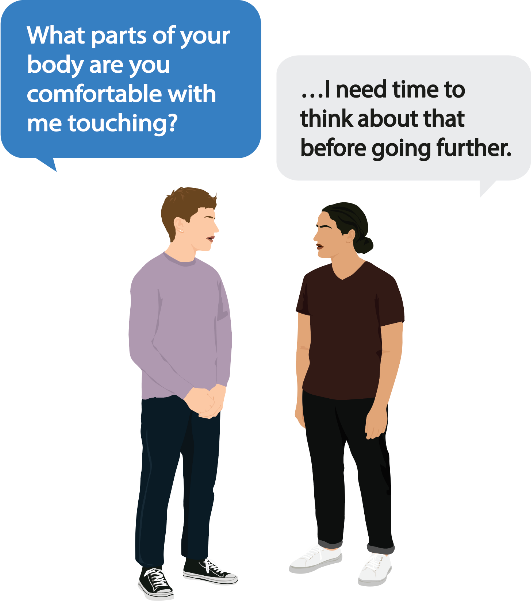
Verbal consent
Verbal consent is a form of external consent that involves using direct spoken communication to give and receive consent to engage in sexual activity.77,78 Verbal communication may also be used to indicate that one does not consent to sexual activity. For example, someone may state, “I don’t want to do that” or “Stop.”79 Females ages 14 to 24 are more likely to rely on verbal forms of sexual communication for both seeking and giving consent and refusal, relative to males in the same age range.80 Other, less explicit forms of verbal consent may include explicitly sexual verbal signals, such as verbal responses to pleasure.81 Less explicit forms of verbal consent may create ambiguity in the situation; if anyone involved is unsure of whether consent was provided, they should ask for more explicit verbal consent to reduce confusion.82 When any person engaged in sexual activity is unclear on whether consent was provided, they must pause and seek clarity before moving forward and respect the decision provided. Consent requires mutual agreement from everyone involved in sexual activity.83 Further, sexually suggestive text messages and/or images can also increase ambiguity around consent, with varying perceptions of consent given and received through sexually suggestive texts.84
Importantly, individuals who have experienced traumatic sexual events and those experiencing ongoing post-traumatic stress symptoms may experience additional barriers to communicating consent or their disinterest in sexual activity.85 Research about ambiguity and coercion in consent is helpful for understanding more about consent among individuals who experience trauma. Individuals may interpret one’s tone or wording differently, and these differences in interpretation may influence one’s understanding of consent. For example, some males may interpret a female’s friendliness toward them as indicative of sexual interest (for more information on differences related to sex, see the section on individual characteristics).86 Verbal consent is also complicated to understand in situations in which a person may provide a verbal agreement to engage in sex, but feel pressured to do so.87 A person has not provided consent if they feel coerced to say “yes,”88 underscoring the importance of youth understanding both internal and external consent when giving, seeking, and receiving consent.
Nonverbal consent
Nonverbal consent involves actions and body language cues to indicate one’s agreement to engage in sexual activity.89 Research demonstrates that young people more frequently use nonverbal consent cues than verbal consent.90 Nonverbal consent may be expressed through positive displays of body language such as smiling, nodding, and leaning into another person; by contrast, nonverbal cues of withholding consent include91 displays of not wanting to engage, such as moving someone’s hand and shifting body positions to reduce access.92 Nonverbal sexual communication can be ambiguous, increasing the likelihood of misinterpretation.93 Therefore, researchers recommend that youth communicate with their sexual partners in multiple ways that combine both nonverbal and verbal communication to clearly express consent and mutual agreement to engage in sexual activity.94 Further, those seeking and receiving consent should pause and ask for clarification if they are unsure whether they received consent, and should respect the decision they are provided.
Youth who have experienced trauma may have unique experiences during sex that impact their ability to provide verbal or nonverbal consent. For example, research shows that survivors of sexual violence report physical arousal during the assault, which is a bodily response and not an indicator of nonverbal consent.95 Furthermore, disassociation (i.e., mental or emotional detachment from one’s body, thoughts, or surroundings)96 related to trauma may also influence consent. People with a history of childhood maltreatment demonstrate higher levels of dissociation than their peers.97 Although dissociation can be a protective mechanism that helps people survive traumatic experiences,98 dissociation during later sexual encounters can complicate one’s ability to provide consent.99 Sensory stimuli during sex can trigger memories of the abuse, and people may react by dissociating in order to continue sex.100 In addition, young adults with chronic maltreatment histories may have “fight, flight, or freeze” responses triggered more easily than young adults with no or nonchronic maltreatment histories.101 Further, young people who have experienced trauma may experience an increased risk of “freezing” or disassociating in subsequent sexual encounters.102,103
Seeking, Giving, and Receiving Consent
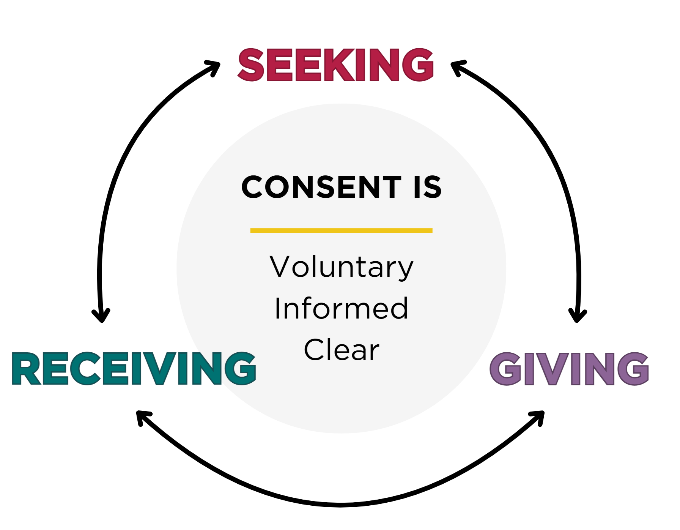
Seeking, giving, and receiving consent represent interrelated and ongoing processes, rather than discrete actions,104 and consent is important for all youth, regardless of their background or individual identity. Meanwhile, individual characteristics (e.g., age and sex), situational influences (e.g., substance use), and relational contexts and histories (e.g., length of relationship, conflict avoidance) may be associated with giving, receiving, and seeking consent.
- Giving consent involves communicating one’s willingness to engage in sexual behavior. It also includes communicating that one does not want to engage in sexual behavior.105
- Seeking consent involves inquiring about whether one agrees to sexual behavior or learning the person(s) does not, either through verbal or nonverbal signs.106
- Receiving consent is the process through which an individual interprets whether they have received consent from another person and acted accordingly.107,108
Individual characteristics
Age
Young people ages 14–24 experience seeking, giving, and receiving consent differently than adults. Younger youth ages 14–18 report many barriers to saying “no,” including trouble setting boundaries, low self-efficacy, impulse control that is still developing, and increased pressure from current or potential partners.109,110 Further, youth in this age range are influenced by pressures from peers related to having sex or negative feelings about not having had sex.111 Adolescence is a dynamic period for brain development, with processes that foster creativity and adaptability, but also challenges related to impulse control, emotional regulation, and decision making112—skills that are needed to assess risk when deciding whether to engage in sexual activity.
Sex
Young people generally use a combination of verbal and nonverbal consent.113 Female young adults may be more likely to communicate and interpret consent using verbal cues compared to young males, who may be more likely to use and perceive nonverbal cues.114,115 However, differences in how females and males communicate consent vary across situations and should not be overgeneralized to apply to all females and males and all situations.116 Scholars discuss that these differences may be rooted in differences in social norms and societal expectations that influence different behaviors between females and males.117 Talking with youth about these expectations and norms can help them understand differences in how their partners might approach consent and highlight the need to obtain clear consent before engaging in sexual activity.
Disability
Many young people with intellectual disabilities are also sexually active and may express and perceive consent differently than young people without intellectual disabilities.118 Furthermore, youth with disabilities experience higher rates of sexual violence than youth in the general population and may lack access to services when an assault occurs.119
Many factors contribute to the ability to consent among youth with disabilities, including knowledge of rights, access to sex education and services, and type of disability. Young people with intellectual disabilities generally have less understanding of their sexual rights and the difference between healthy, consenting relationships and abusive relationships, relative to their peers without intellectual disabilities.120,121 The decreased understanding of sexual rights and healthy relationships is, in part, due to a lack of accessible sex education provided to individuals with intellectual disabilities.122 Yet youth with intellectual disabilities do have bodily autonomy, and access to sexual and reproductive health education can help youth with disabilities understand consent and make informed decisions about whether to engage in sexual activity (or decline to engage).123 Additionally, youth who are nonverbal and need other methods for providing consent may experience additional complexity during the consent process.124
Situational factors
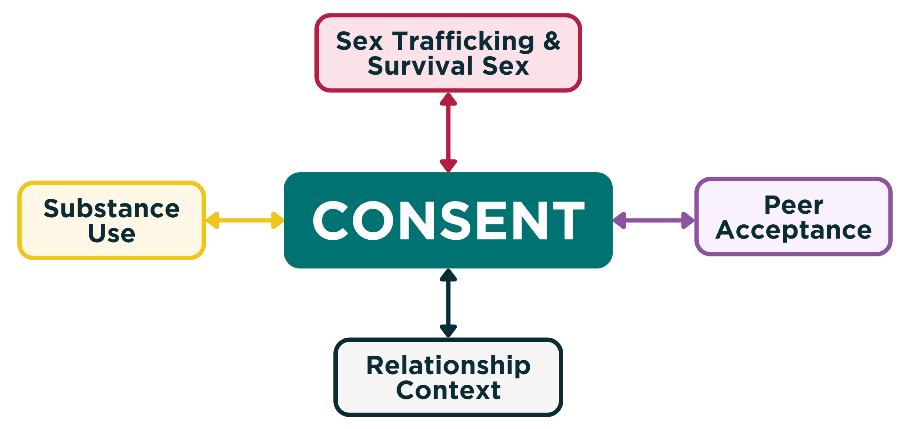
Substance use
Substance use can influence one’s ability to seek, give, and perceive consent because substances impact brain function and impulse control.125,126 Research does not conclude that substance use rules out the ability to give consent, but it does find that being under the influence of substances can significantly alter or complicate cognition, feelings, communications, and perceptions related to consent.127,128 There are instances in which one cannot provide consent due to substance use—for example, when one’s speech is slurred or one is incapacitated, passed out, or unable to walk.129 A study of young adults found that using alcohol (alone or in combination with cannabis) was associated with lower levels of internal consent, compared with sexual interactions that did not involve either substance.130 In another study, young women reported using more verbal communication of consent when using alcohol than when they were sober.131 Together, findings from these studies suggest that being under the influence of substances can impact a young person’s feelings about consent and their methods for communicating consent in varying ways.
Some research has found that substance use may create misperceptions when giving, seeking, and receiving consent.132 For example, studies find that, among young adults, accepting alcohol from a potential partner or drinking together may be perceived as nonverbal indicators of consent.133,134 Researchers who interviewed 145 young adults ages 18 to 25 found that some participants reported relying on “intoxication parity” (i.e., perceiving that both parties were experiencing similar levels of intoxication) when deciding whether consent can be given during a sexual encounter under the influence of substances.135
Peer acceptance
Peer acceptance, or how young people are perceived by their peers, has been shown to be impacted by youths’ engagement—or lack thereof—in sexual activity. For example, females who have sex report lower levels of peer acceptance, while males who have sex report higher levels.136 Additionally, youth’s perceptions of their peers’ sexual behavior have been shown to be one predictor of their own sexual activity and behaviors.137 Perception of their peers’ sexual activity can impact youth’s views of consent and the degree to which they feel pressured to engage in sexual activity.
Sex trafficking and survival sex
Youth involved in the child welfare system and/or those experiencing childhood maltreatment, youth experiencing homelessness, and those disconnected from work and school experience are at an increased risk for sex trafficking victimization138 and engaging in survival sex.139,140 Young people who experience homelessness may feel that survival sex is required to meet such basic needs as housing and food. Indeed, research demonstrates that the length and frequency of experiencing homelessness are related to increases in engaging in survival sex.141 Youth and young adults experiencing sex trafficking or commercial sexual exploitation are also at increased risk of being involved with the juvenile or adult criminal legal systems because state laws largely prohibit sex work.142,143
Although the law generally prohibits sex work, young people who experience sex work may not realize they are being trafficked nor understand whether (or not) they are consenting to sex. A systematic review of 24 studies found that those who recruit youth into sex trafficking are most often identified as a partner (e.g., boyfriend/girlfriend) or friend.144 Further, youth may not realize they are being trafficked, which can significantly impact their views of and experiences with seeking, giving, and receiving consent. Understanding consent within the context of sex trafficking and survival sex is critical for young people because engaging in commercial or transactional sex can place them at higher risk of PTSD and other mental health challenges,145 as well as sexual assault victimization, negative health outcomes, and unmet needs for services (e.g., health care).146
Relational contexts
Different relational contexts and histories may influence consent, such as length of relationship, conflict avoidance among partners, and societal pressures. Studies about how young adults in long-term relationships communicate consent suggest that many people reduce explicit consent-seeking over time and instead rely on nonverbal cues and body language.147,148 Although prior consent does not imply or provide consent for future sexual encounters, the type of consent one seeks and gives can change over time when there is sexual precedent between people.149
Additional relationship dynamics may also influence consent. For example, some young people report engaging in sex to avoid conflict or disagreement, or simply because they want to make their partner happy.150 Young people may also feel that they owe someone sex or that their partner expects sex, or they may otherwise fear the social costs of withholding consent.151 Trauma experiences can affect one’s sexual self-efficacy, or the belief that they can navigate sexual activity, make choices to engage in sex, and communicate those decisions.152 Together, these factors suggest that histories of trauma may impact a youth’s ability to negotiate sexual situations with a partner (e.g., giving, seeking, and/or receiving consent).
Complexities and Caveats of Consent
Consent and the decision to engage in sexual activity sometimes must be about more than mutual sexual agreement. First, professionals who support youth, young people, and their partners should understand local law regarding statutory rape and the legal age of consent. Even in situations where there is mutual sexual agreement between youth, there can be legal ramifications to engaging in sexual activity. The legal age of consent varies by state, with some states considering only the age of each participant and other states considering additional factors such as the age gap between those involved.153 Often, these issues are addressed in penal codes as to what constitutes various forms of sexual violence.154 In some states—such as Texas,155 Arizona,156 and Pennsylvania157—there are exceptions to sexual activity laws when consensual sex occurs between individuals within close age proximity to one another, known as “Romeo and Juliet” laws.158,159
Further, definitions of legal consent vary across locales, institutions, and organizations.160 Some laws, regulations, and policies at the state, local, or even institutional levels (e.g., an institution of higher education) may stipulate particularities regarding consent, such as requiring “affirmative consent” or “enthusiastic consent.”161 Failure to follow such policies can have different ramifications. When youth-supporting professionals are aware of regulations (and exceptions) in their jurisdictions that are applicable to the youth they support, they can help youth understand the complexities involved in decisions about various sexual activities. The Age of Consent website provides information about different laws and regulations pertaining to consent, such as the legal age to provide consent and when something is considered statutory rape. For youth-supporting professionals who are mandated reporters, it is important to know when criminalized sexual activity is reportable as child abuse and when it is not and to help the youth they support understand these implications.
Gaps in Existing Research
Throughout our literature search, we identified several gaps in existing research and practice literature. First, much of the literature focuses on samples drawn from college or university settings. Starting developmentally appropriate conversations about sexual activity early and as children age can lead to positive outcomes for youth.162 Therefore, incorporating conversations and education about consent prior to college might be positive for youth and should be examined in future research. Furthermore, focusing on college populations may exclude many subgroups of young people such as those experiencing the child welfare and/or juvenile justice systems, homelessness, or disconnection from work and school. Much research also focuses on largely White youth samples, although research with young people across various racial and ethnic groups is becoming more common.163 Lastly, based on our review, there is limited evaluation evidence focused on strategies to improve consent-related outcomes, including increasing young people’s awareness of consent and their role in declining to engage in sexual activity.
Conclusion
Research describes multiple forms of consent, including external, internal, and legal consent. The definitions vary, as do the nuances that must be considered when understanding how the various forms of consent are communicated. Research also shows that individuals who have experienced trauma may seek, give, and receive consent differently than those who have not experienced trauma. For example, youth who experience trauma may be less assertive in providing consent and/or declining to consent. The ways youth seek, give, and receive consent are influenced by individual factors, such as self-efficacy; situational factors, such as substance abuse; and relational factors, such as the length of relationships and power dynamics within a relationship. Given the complex, multi-layered nature of giving consent or declining to consent, professionals can use this summary to strengthen support for youth through deeper knowledge about trauma- and evidence-informed information about consent.
Footnotes
- Fully able includes that one is free from coercion and not incapacitated. ↩
- Fully able means that one is free from coercion and not incapacitated. ↩
- For more information on state’s mandated reporting requirements, please see the following two citations. The National Center for Youth Law summarizes key information on age of majority and access to reproductive services and the ASPE report provides a breakdown of different components of mandated reporting by state. ↩
- The asterisk denotes a search for any variation of “ed,” such as education or educating. ↩