Introduction
This guide introduces the concept of consent for sexual activity and provides an overview of what youth-supporting professionals need to know about the topic of consent to inform their work with youth. The guidance is designed for youth-supporting professionals working with young people who experience the child welfare and/or juvenile justice systems, homelessness, and/or disconnection from work and school. Research indicates that young people with these experiences have higher rates of trauma than their peers in the general population, which can affect how consent for sexual activity is understood and communicated.a Therefore, the information in this guide draws on trauma-informed research and guidance to ensure clarity and compassion in youth-supporting professionals’ interactions with young people.
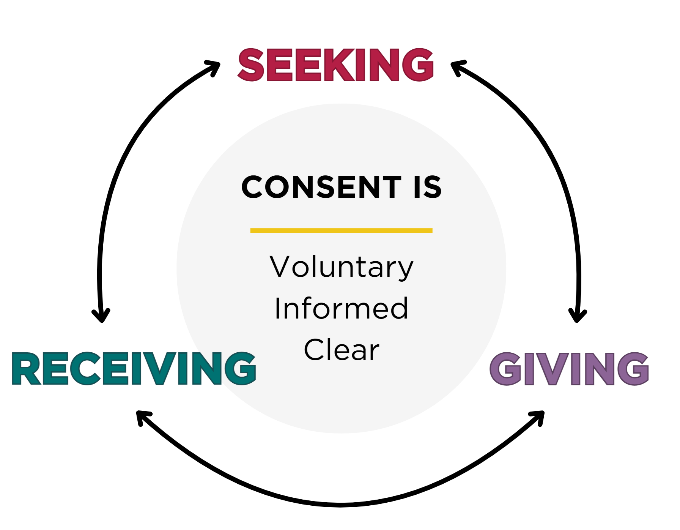
Consent for sexual activity (hereafter consent) is defined as a voluntary, informed agreement to engage in sexual activity conveyed through clear words or actions by individuals who are fully able to make this decision.1,2 Since we define consent as the agreement for sexual activity, we also note the equally important decision to decline to engage in sexual activity throughout this guide. Consent is an active, ongoing process that includes the freedom to agree and the right to decline.3 This process has three interconnected processes:
- Giving consent—communicating one’s willingness to engage in sexual behavior. This process also includes communicating that one does not want to engage in sexual behavior.4
- Seeking consent—inquiring about whether one agrees to sexual behavior or learning the partner(s) does not agree through verbal or nonverbal signs.5
- Receiving consent—the process through which an individual interprets whether they have received consent from another person and acts accordingly.6,7
Consent can take different forms, including external and internal consent. External consent is clear communication about agreement to engage in sexual activity.8 Internal consent refers to how one feels about their affirmative decision to engage in sexual activity.9,10 Both forms of consent are important and inform how a young person might feel about, think about, and communicate consent. Discussing the importance of internal and external consent should not be misconstrued as evidence of the myth that if a young person says “no,” they mean “yes”. Consent-related messaging focused only on external consent may overlook that not all young people feel safe or feel able to say “no” in all situations. For example, someone might say “yes” to an activity with which they do not feel comfortable but are afraid of negative repercussions if they say “no.” Additionally, young people must respect the consent they receive. Further, if a potential partner hesitates or a young person is unsure if they received consent, they must pause, clarify if consent was provided, and stop if needed.11
Legal definitions mostly focus on external consent and vary by state. These definitions usually include factors such as age, intoxication (voluntarily and involuntarily), and consciousness. Youth-supporting professionals need to understand how consent is legally defined in the state where they work, including the state’s mandatory reporting laws, specifically regarding young people’s disclosure of sexual activity that may involve sexual assault or exploitation. For more information on states’ mandated reporting requirements, see the following two resources: The National Center for Youth Law summarizes key information on age of majority and access to reproductive services, and this federal report provides a breakdown of different components of mandated reporting by state.
What do youth-serving professionals need to know about consent?
Youth-supporting professionals can help young people understand consent in developmentally- and age-appropriate ways,12 regardless of a young person’s experience with sexual activity.13 Further, youth-supporting professionals can use this information to enhance their awareness about different influences on consent and inform their work to support young people. Youth-supporting professionals must remember that while understanding more about consent can help young people make informed decisions about engaging in sexual activity, consent education alone is not enough to prevent unwanted sexual activity.14 Sexual violence prevention programs incorporate several other elements beyond consent to ensure that young people understand what sexual violence is, what resources are available to them if they have experienced sexual violence, and how to receive consent respectfully.15
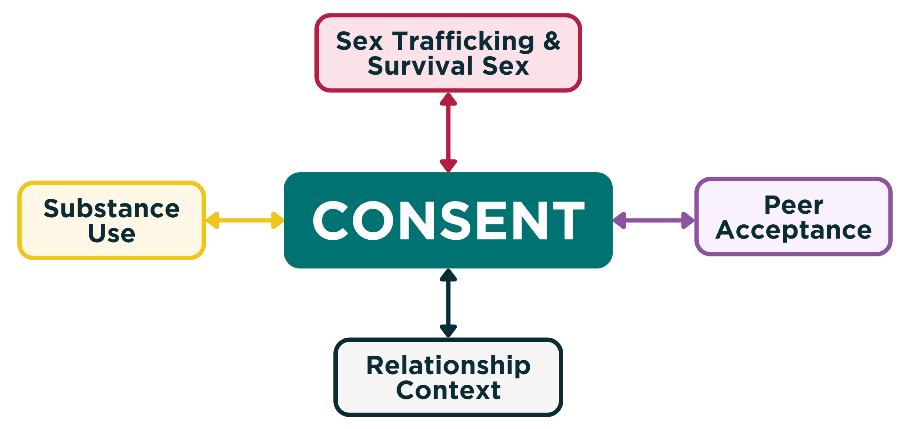
The following table provides more information on the influences of consent—biological (e.g., age and sex), social (e.g., substance use), and other factors (e.g., relationship dynamics and survival sex).16 Youth-supporting professionals can use this table to learn more about differences in how young people might approach giving, seeking, and receiving consent based on different factors. This information will not apply to all young people with these experiences but can provide a starting point for talking about consent with different groups of young people.
Influences on Consent
| Influence | Influences on consent youth-supporting professionals should know: | Tips for sharing information with a young person about influences on consent: |
|---|---|---|
| Age | Young people ages 14-18 report barriers to declining to engage in sexual activity. They are still developing self-efficacy skills and may be more susceptible to peers influencing their views about sexual activity and consent.17,18 | You may feel pressure to consent, but you should not say yes if you do not want to. |
| Sex | Some females may be more likely to give verbal consent, while some males may be more likely to use nonverbal cues to communicate their consent or decline to engage in sexual activity.19,20,21 However, these differences may be due to societal expectations and norms.22 | Some females are more likely to use words to communicate consent, and some males are more likely to use body language to communicate consent. However, this might be due to pressure people feel to act a certain way. You should always clearly ask for, give, and receive consent. |
| Substance Use | Substance use can influence youth’s communication, behavior, and perception in ways that complicate giving, seeking, and perceiving consent.23,24,25,26,27 | Being under the influence of drugs or alcohol can make it harder to communicate consent or refusal and can make it harder to understand what others are saying or feeling. |
| Relationship Dynamics | Young people might engage in sex to avoid conflict or make their partner(s) happy.28 Young people may also feel they owe someone sex and fear the consequences of withholding sex.29 | You may find it is difficult to say no to a partner if you are afraid you will upset them. You can always say no if you don’t want to engage in sexual activity. |
| Survival Sex | Young people who engage in sex to meet basic needs30 may have different experiences giving, seeking, and receiving consent. For example, a young person may feel like they have to say yes to sex to access housing,31 which can change how they give and receive consent. | If someone is struggling to meet their basic needs like housing or food, they may feel pressured to agree to sex in exchange for money, food, or a place to sleep. If you find yourself in that situation, you do not need to say yes to having sex just to get the things you need. You can reach out to an adult (like me) who can help. |
Communicating Consent
Verbal communication about consent reduces ambiguity and is the clearest way to communicate interest or disinterest.32 You can remind youth that verbal cues can help avoid ambiguity or misinterpretations since youth often rely on nonverbal cues about consent.33,34 The following table provides examples of verbal and nonverbal cues for communicating consent. This information can help youth-supporting professionals talk with young people about ways that consent is given, including examples of refusals to engage in sexual activity.
Ways Young People Might Communicate Consent
| Type of Communication | Giving consent to engage in/continue sexual activity (Examples)* | Declining to engage in/continue sexual activity (Examples)* |
|---|---|---|
| Verbal Cues Only |
Providing direct, spoken communication agreeing to an activity35,36
Before: “Yes, I’d love to do that!”37 During: “I really like this! I’d love to keep going.”38 |
Saying clearly and directly that you do not want to do something
Before: “No, I’d rather not do that.”39 During: “I’m not having fun anymore. I want to stop.”40 |
| Nonverbal Cues Only |
Displaying actions and/or body language to show you’re comfortable, interested, and/or in agreement with the activity41
Before: Excitedly nodding when someone suggests an activity in which you’d like to engage.42 During: Taking a step closer or holding someone tighter during an interaction such as a hug.43 |
Displaying actions and/or body language to show you’re uncomfortable, not interested, and/or not okay with the activity
Before: Frowning and shaking your head or moving away when someone suggests an activity in which you do not want to engage. During: Pulling away from an interaction or pushing someone’s arms or hands away.44 |
| Verbal and Nonverbal Cues |
Using words and body language to show agreement
Before: “Yeah, a hug sounds nice,” while opening your arms.45 During: “This is nice,” while leaning into the person you are hugging.46 |
Using words and body language to show refusal
Before: “No, I don’t want a hug,” while stepping away.47 During: “Please let go,” while pulling away from a hug.48 |
*The examples provided in this table are informed by the research studies included in the accompanying research synthesis, Seeking, Giving, and Receiving Consent for Sexual Activity.
Footnotes
- For more information on how trauma is associated with consent, please see the accompanying research synthesis, Seeking, Giving, and Receiving Consent for Sexual Activity. ↩