Introduction
Crucial Conversations About Healthy Romantic Relationships focuses on three critical domainsa of healthy romantic relationships:1 communication, such as sharing thoughts/feelings; boundaries/limits, including setting, enforcing, and respecting boundaries and limits; and shared power, such as negotiating roles and responsibilities.
This toolkit is for you: professionals who support teens and youth who experience the child welfare and/or justice systems, homelessness, and/or disconnection from school and work. The Toolkit has four sections that can be used together or as standalone tools to help you with the following:
- Lay the foundation for talking to young people about healthy romantic relationships—Includes helpful tips and groundwork that may be needed while talking with teens about healthy romantic relationships.
- Start conversations with youth about healthy romantic relationships—Includes strategies for starting the conversation, continuing the conversation, and checking in after the conversation.
- Know the dos and don’ts for talking with teens and youth about healthy romantic relationships—Includes a list of things to consider doing, or to avoid, while talking with youth about healthy romantic relationships.
- Identify additional resources to help you support youth to have healthy romantic relationships.
This tool is based on a research summary from Activate which describes healthy romantic relationships and youth well-being. Healthy romantic relationships are developmentally appropriate during adolescence and young adulthood.2,3 Young people who engage in healthy relationships may experience better outcomes such as decreased mental health concerns, higher overall life satisfaction, and higher self-esteem.4 However, young people who experience the child welfare and/or justice systems, homelessness, and/or disconnection from school and work may be at an increased risk for unhealthy romantic relationships, such as abusive relationships and those that involve sexual exploitation.5–7 This increased risk may be due to:
- Limited experience observing and experiencing healthy relationships8–10
- General instability in housing and school, which may create instability in relationships11
- Experiences with trauma associated with instability, systems-involvement, homelessness, and/or disconnection from school12–14
You can use this toolkit to help youth understand the components of healthy romantic relationships, navigate conversations with partners, and identify where to turn for support if they are in an unhealthy romantic relationship.15 Although the toolkit focuses on romantic relationships, much of its guidance applies across types of relationships (e.g., relationships with friends, peers, adults, parents).
Laying the Foundation to Talk to Young People About Healthy Relationships
When talking with youth about healthy romantic relationships, consider how well you are prepared for the conversation.16 This tool outlines six conditions that may help you talk to young people about healthy relationships, why those conditions are important, and how you can cultivate these conditions for the youth you support.
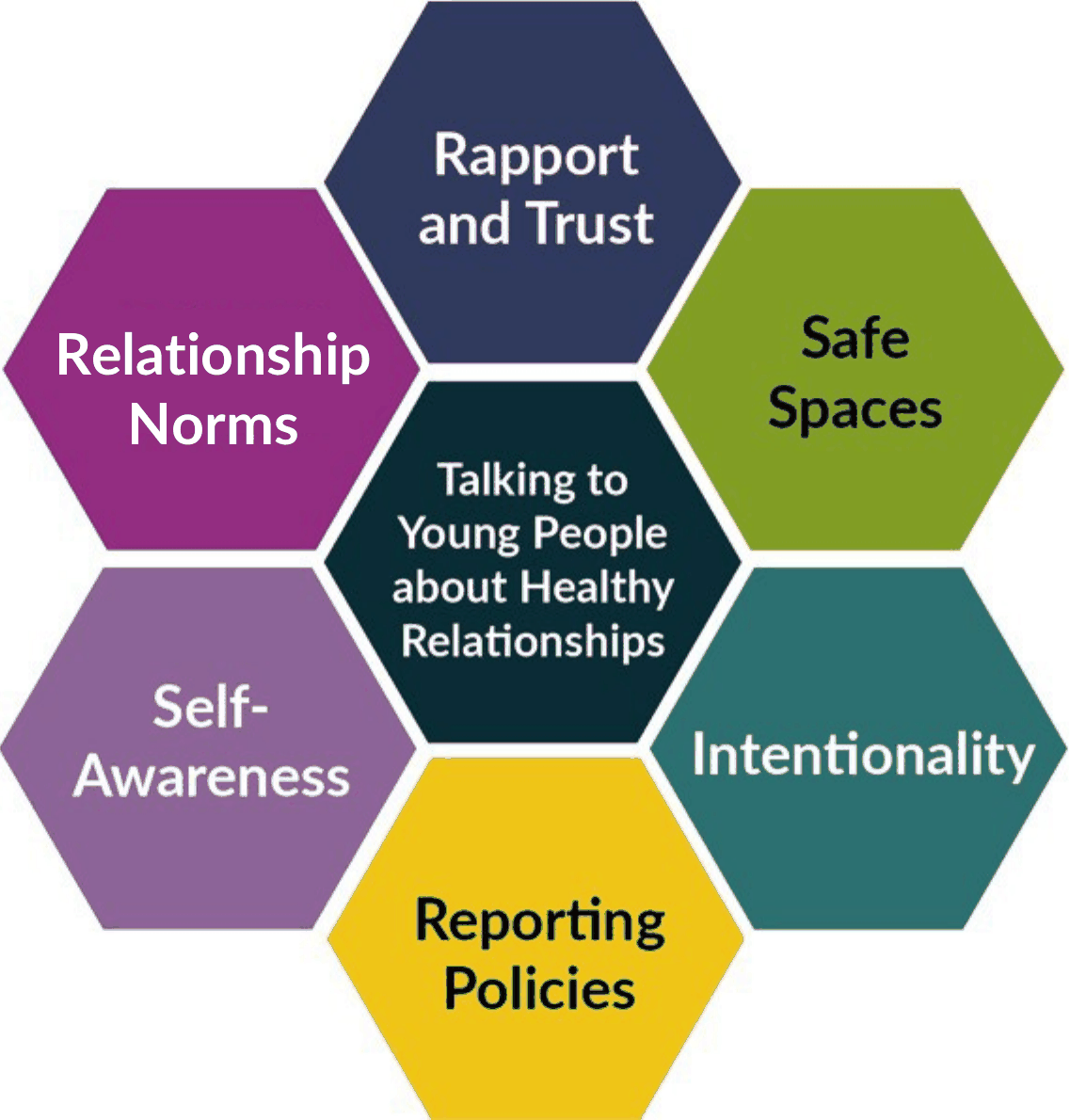
You can establish the foundation for talking to young people about healthy relationships when you:
- Develop rapport and trust with the young person.
- Create a welcoming and private space.
- Prepare for, engage in, and follow up with youth intentionally.
- Remain self-aware and willing to reflect on your own assumptions.
- Maintain your knowledge of state-mandated reporting policies.
- Pay attention to relationship norms.
For more information on laying the foundation for talking about healthy relationships with youth, see section four of this toolkit: Additional Resources for Talking With Youth About Healthy Romantic Relationships.
Conditions for laying the foundation for talking with youth
| Why is this condition important? | How do I create the condition? |
|---|---|
| Build rapport and trust with a young person to ensure they feel heard, understood, and supported. Trust helps youth feel comfortable discussing healthy relationships.17 | Trust and rapport are built over time. You can build trust and rapport when you 1) actively listen, 2) respond without judgment, and 3) show authenticity. You can help empower, advocate for, and guide youth through challenging situations in their relationships.18,19 |
| Why is this condition important? | How do I create the condition? |
|---|---|
| A welcoming and private space can help youth feel comfortable talking about themselves and their romantic relationships.20,21 | Reduce distractions that can cause anxiety (e.g., visual, auditory, and motion over-stimulation).22,23 Create opportunities for youth-led individual or group sessions and for youth to express themselves creatively (e.g., through art or play).24,25 |
| Why is this condition important? | How do I create the condition? |
|---|---|
| Be intentional in how you approach interactions with youth. Help youth have an honest and open dialogue.26 | Ensure that time with youth is meaningful. Plan topics ahead of time but prioritize allowing youth to drive what is most important.27 Work with youth to set an agenda, ask specific and open-ended questions, set goals, and provide resources and/or homework between interactions.28 |
| Why is this condition important? | How do I create the condition? |
|---|---|
| Self-awareness helps you understand your emotions, strengths, and areas for growth in conversations with young people.29,30 | Take steps to develop greater awareness of your own strengths, challenges, and areas for growth. Engage in ongoing professional development and learning (e.g., work-related professional development resources, case conferencing, and/or clinical supervision if available).31,32 |
| Why is this condition important? | How do I create the condition? |
|---|---|
| Be clear with youth about what you legally must report to authorities (e.g., abuse) when disclosed. This ensures that youth feel comfortable having open and honest conversations. | Learn mandated reporting policies in your state. Have conversations about those policies with youth.33 |
| Why is this condition important? | How do I create the condition? |
|---|---|
| Talk with youth about differences in norms related to healthy relationships. Work with youth to navigate their own beliefs and those of their current and future partner(s).34 | Talk about differences in communication styles, relationship roles and expectations, and views of healthy romantic relationships. For example, some people communicate with both verbal and nonverbal cues while others just focus on verbal cues.35 |
Conversation Starters for Talking with Youth About Healthy Romantic Relationships
Communication, boundaries/limits, and shared power are key components of healthy romantic relationships that are critical for young people who experience the child welfare and/or juvenile justice systems, homelessness, and/or disconnection from school and work—according to the young people and youth-supporting professionals who advised this work.
You can use these conversation starters to initiate discussions with young people. For each component—communication, boundaries/limits, and shared power—you will find a definition and suggested conversation prompts to help you start the conversation, continue the discussion, and follow up after the conversation. These prompts are not exhaustive.
Communication
Communication is how partners in a relationship express their thoughts and feelings, both verbally and nonverbally.36,37 Healthy communication includes active listening, honesty, emotional regulation, and self-awareness.38,39 Preferences and styles may vary from youth to youth depending on their expectations and experiences.40–42
Experience in the child welfare and/or juvenile justice systems, homelessness, and/or disconnection from school and work may limit young people’s opportunities to learn communication skills and practice these in safe relationships with parents, siblings, and friends due to frequent moves or unstable placements. Through these conversation starters, you can help young people reflect on their communication styles and strengthen their verbal and nonverbal communication skills.
Use these conversation starters to talk with youth about communication in their romantic relationships.b
| Active listening | |
|---|---|
| Getting started |
|
| Continuing discussions |
|
| Following up |
|
| Honesty about wants and needs | |
| Getting started |
|
| Continuing discussions |
|
| Following up |
|
| Nonverbal communication | |
| Getting started |
|
| Continuing discussions |
|
| Following up |
|
Boundaries/limits
Boundaries/limits are an individual’s expectations and limits of what behaviors are acceptable or not acceptable within their relationships.43 Individuals generally have physical, material, mental or intellectual, and emotional boundaries/limits.44 Understanding and recognizing boundaries/limits is essential for establishing and maintaining a healthy romantic relationship. Healthy boundaries/limits allow youth to feel comfortable with expectations in their relationships.45
Time spent in the child welfare and/or juvenile justice systems, homelessness, and/or disconnection from school and work can leave young people with little control over how they are treated in those relationships and their lack of autonomy within those relationships.46 Therefore, youth may have less practice establishing boundaries/limits in relationships and need additional help figuring out their boundaries/limits and communicating those to other people.
Use the conversation starters below to talk with young people about boundaries/limits in their romantic relationships.
| Establishing boundaries/limits | |
|---|---|
| Getting started |
|
| Continuing discussions |
|
| Following up |
|
| Physical boundaries | |
| Getting started |
|
| Continuing discussions |
|
| Following up |
|
| Personal belongings | |
| Getting started |
|
| Continuing discussions |
|
| Following up |
|
Shared power
Shared power means that partners in a relationship support and respect one another and have balanced, mutually agreed-upon roles and responsibilities.47–49 People in relationships with shared power tend to be more satisfied in their relationship and may experience better mental health.50
Talking about and understanding shared power in romantic relationships is complex.51 Youth experiencing the child welfare and/or juvenile justice systems, homelessness, and/or disconnection from school and work may have limited examples of shared power in relationships due to a lack of stability in their homes and living arrangements and few opportunities to openly discuss power-sharing.
Use these conversation starters to talk with young people about shared power in their romantic relationships.
| Input in decision making | |
|---|---|
| Getting started |
|
| Continuing discussions |
|
| Following up |
|
| Influence of relationship norms and expectations | |
| Getting started |
|
| Continuing discussions |
|
| Following up |
|
| Agreement about power sharing | |
| Getting started |
|
| Continuing discussions |
|
| Following up |
|
Dos and Don’ts for Talking with Youth About Healthy Romantic Relationships
You can use these dos and don’ts to guide your conversations with young people about healthy romantic relationships. Approach each conversation with empathy, willingness to listen and learn, and commitment to improve.c For more information on dos and don’ts for talking with youth about healthy relationships, see section four of this toolkit: Additional Resources for Talking With Youth About Healthy Romantic Relationships.
The following list of recommendations is not exhaustive but provides a starting point for talking with young people about healthy romantic relationships:
- Create an open and judgement-free zone.
- Help young people explore their experiences rather than labeling them.
- Validate young peoples’ feeling and experiences.
- Approach conversations with an open mind.
- Use a trauma-informed lens.
- Respect youth’s privacy and be transparent about limits to privacy.
You can find examples about dos and don’ts for talking with youth about healthy romantic relationships below.
| DOS | DON’TS |
|---|---|
|
DO ask nonjudgemental, open-ended questions. “Can you walk me through the interaction and how it made you feel?” |
DON’T use language that can be interpreted by the young person as implying blame or shame. “It might not have been productive to react like that. You probably should have reacted a different way.” |
|
DO encourage youth to reflect on the full range of experiences and feelings. “It sounds like your partner may have made you feel unsafe or uncomfortable by doing that.” |
DON’T rely on overly simplistic labels. “Your partner was being abusive toward you.” |
|
DO validate feelings, experiences, and fear. “Disagreements in relationships can be really stressful, and it’s possible for partners to disagree about something without overstepping each other’s boundaries.” |
DON’T trivialize experiences, fears, needs, or wants. “It’s unrealistic to set a boundary to prevent disagreement or arguments from ever happening.” |
|
DO ask the young person about their knowledge on a subject and fill in gaps. “It can be difficult for someone to know if they’re in an unhealthy relationship. What does a healthy relationship look like to you?” |
DON’T make assumptions or generalizations about what a young person does or does not know. “Young people are too naïve and inexperienced to recognize when they’re in an unhealthy relationship.” |
|
DO understand that the young person did what felt safest for them in the moment and validate them. “It can be really difficult to know what to do in that situation.” |
DON’T ignore complexities of a situation. “You should have left the relationship as soon as the problems started.” |
|
DO tell youth what is private, as well as what must be disclosed (and when). “I want you to feel safe sharing things with me, but there are things—like if someone hurt you or you are thinking about hurting someone else—that I’m legally required to report to authorities. We can talk more about that if you have questions.” |
DON’T assume young people know what must be disclosed or that everything is confidential. “Don’t worry, everything you tell me will stay between us.” |
Additional Resources for Talking with Youth About Healthy Romantic Relationships
You can use the resources below to access additional information about components of healthy relationships, building communication skills, boundaries/limits, and shared power.
| Resource name and link | Resource description | Use this resource to… |
|---|---|---|
| National Healthy Marriage Resource Center, The Annie E. Casey Foundation, and Innovation Center for Community and Youth Engagement (2019). Relationships matter: Strengthening vulnerable youth | This report reviews the importance of healthy relationships among youth and how to discuss them with youth. | Gain knowledge and comfort about healthy romantic relationships. |
| John Hopkins University (2020). 12 elements of healthy relationships | This blog explores elements of healthy relationships and provides links to resources for additional information. | Gain additional examples of how to talk with youth about healthy relationships. |
| Shipley, M., Holden, C., McNeill, E. B., Fehr, S., & Wilson, K. (2018). Piecing Together Behaviors of Healthy Relationships. Health Educator, 50(1), 24-29. | Table 1 of this resource describes characteristics of healthy relationships for teens and unhealthy relationship characteristics. | Gain knowledge of healthy relationships and signs of healthy and unhealthy relationships. |
| Forbes Health (2024). How to communicate in a relationship, according to experts | This article outlines different forms of communication and provides examples of good and bad communication. It also provides additional examples of conversation starters to use with youth. | Prepare for conversations with youth and see prompts for starting those discussions. |
| Positive Psychology (2024). How to Set Healthy Boundaries and Build Positive Relationships | This article defines boundaries, provides examples of healthy boundaries, and includes links to other helpful resources. | See examples of additional conversation starters to use with young people. |
| Therapist Aid (2016). What are personal boundaries? | This article provides different types of boundaries and characteristics of people within each boundary type. | Provide youth with examples of different types of boundaries and utilize the self-reflection questions in your work to help youth set boundaries. |
| Mass.Gov (n.d.). Boundaries in healthy relationships | This webpage provides components of healthy and unhealthy relationships, provides guidance on how to think about and set boundaries, and offers conversation prompts to discuss boundaries with partners. | Inform your work by reviewing additional information on healthy and unhealthy relationship components. |
| Eastland County Crisis Center (n.d.). Relationship Equality Wheel for Teens | This infographic provides information on different components of nonviolent relationships. | Talk through different elements of a relationship as they work through shared power in their relationships. |
| Love is Respect (n.d.). Power and Control | This webpage provides information on different power dynamics and ways that partners may control one another. | Review aspects of healthy and unhealthy relationships to explore potentially controlling behavior. |
| Love is Respect (n.d.). 4 things that make a relationship healthy or unhealthy | This blog provides information on characteristics of a healthy and unhealthy relationship. The resource provides different elements of shared power. | Identify different elements of shared power. |
Footnotes
- The domains were identified by a group of young people with lived expertise, program administrators and direct service providers who support them, and other experts on sexual and reproductive health working with systems-involved youth, youth experiencing homelessness, and disconnected youth. ↩
- All prompts in this document are informed by the research literature on healthy romantic relationships. ↩
- Factors such as relationship norms play an important role in conversations about healthy romantic relationships. For more information about considerations to keep in mind when talking about healthy relationships with youth, see “Laying the Foundation.” ↩