Purpose
Young parents must often balance the experience of being parents with the experience of being parented by the adult caregivers in their lives (e.g., parents, grandparents, extended family members, foster caregivers, congregate care staff). To effectively support young parents, professionals must understand the relationships these young parents have with their own parents and other adult caregivers.
This summary describes research about the relationships between young parents and their adult caregivers, with additional considerations for professionals who support young people and families who face unique adversities. Youth and families who have been impacted by the child welfare and/or juvenile justice systems, homelessness, and/or disconnection from school and work may face additional challenges that can shape the experience of young parenthood, young parents’ relationships with caregivers, and what they need from youth-supporting professionals.
Youth-supporting professionals can use the research summarized in this brief to support young parents (and their caregivers) as they navigate the dual experiences of parenting and being parented during the transition to adulthood.
Background
Although rates of adolescent pregnancy in the United States have declined significantly in recent decades,1 nearly 141,000 adolescent girls ages 15 to 19 gave birth in 2023.2 Young people who have experiences with child welfare and/or juvenile justice systems, homelessness, or disconnection from school and work (i.e., opportunity youth) are more likely than their peers in the general youth population to report a pregnancy and/or birth.3,4,5,6
- Based on recent data from the National Survey of Family Growth (NSFG), 41 percent of female opportunity youth reported ever experiencing a pregnancy and 32 percent reported having a child, which was twice as high as their connected peers.7 Among male opportunity youth, 15 percent reported ever experiencing a pregnancy and 8 percent reported having a child.8 Data show that teenage mothers are, on average, more likely than their peers to drop out of high school9 or to experiencing higher instances of housing instability due to pregnancy.10
- A brief survey administered to unaccompanied youth and young adults experiencing homelessness across 22 U.S. counties found pregnancy and parenthood rates to range from 3–10 percent for youth ages 13 to 17, and 29–43 percent for young adults ages 18 to 25.11
- Research notes similar trends for youth who experience the child welfare system. In the National Youth in Transition Database (NYTD) survey, 38 percent of females had given birth by age 21.12 Among young women in Pennsylvania who were previously in foster care, nearly 44 percent reported ever being pregnant.13 Reports of maltreatment to child protective services are linked to higher rates of adolescent pregnancy.14
- About 25 percent of girls currently detained in the juvenile justice system report ever being pregnant.15 Arrest history among high school students has been associated with becoming a parent before age 25.16 In a study focused on youth who experience both the child welfare and juvenile justice systems, nearly 32 percent reported ever being pregnant or causing a pregnancy.17
Few studies capture the proportion of actively parenting youth who experience the child welfare and/or justice systems, homelessness, or disconnection from school and work. However, available research demonstrates the need to focus more on young parents with these experiences as they navigate parenthood and adolescence simultaneously.
Summary of Findings
In general, young parents have the same legal rights and responsibilities as adult parents under both federal and state laws—even when they are minors.18 However, young parents under age 18 are also still legally entitled to caregiving by their own parents or caregivers. The legal and practical realities of parenting while being parented can create confusion about the respective responsibilities of young parents and their adult caregivers. Furthermore, parenting roles and responsibilities can vary greatly depending on the age and developmental needs and abilities of the young parent.19,20,21 For example, the needs and parenting abilities of a 14-year-old parent are likely to be very different from those of a 22-year-old parent, given brain development and executive functioning skills.22,23
A balancing act: Normative adolescent development and early parenthood
Adolescence can be a challenging time for all youth, introducing changes and even strain into their relationships with parents and caregivers. Normative adolescent development involves taking risks, exploring identities, and seeking more independence from caregivers—behaviors that can shape identities among emerging adults.24 Adolescence is also marked by increased conflict between youth and their parents/caregivers, as young people negotiate their increased desire for independence and push back against parental authority.25,26,27 While often stressful, developmental science shows that parent-adolescent conflicts are also important opportunities for relationship change and evolution, as adolescents and parents adjust to the young person’s shift away from childhood and toward emerging adulthood.28
Changes to familial relationships during adolescence can be further complicated when an adolescent becomes a parent themselves.29,30 Like most adolescents, adolescent parents are learning to navigate what it means to be independent. For adolescent parents, independence also includes making decisions about their child and experiencing shifts in roles, responsibilities, and relationship dynamics in their families.31,32
A small body of research has found that adolescent parents face “conflicting parenting and developmental demands,” which can be a source of increased and unique parenting stress.33 In interviews with 31 young adults who became mothers as adolescents, respondents described growing up with their own children (e.g., “we grew up together”) and handling the “balancing act.”34 The balancing act is defined as juggling the demands of parenthood while navigating the experiences of adolescence.35 Based on the research identified in our scan, three central ideas emerged around what young parents and their adult caregivers find themselves having to balance: (1) relationship dynamics, (2) autonomy and decision-making power, and (3) roles and responsibilities. When available, we specifically highlight research about youth who experience the child welfare and/or justice systems, homelessness, and/or disconnection from school, and what additional considerations are critical to understanding their experiences of parenthood.
The following graphic visually depicts the difficult balancing act young parents and their adult caregivers may experience in this unique developmental period—and in the unique context of adolescent parenthood.
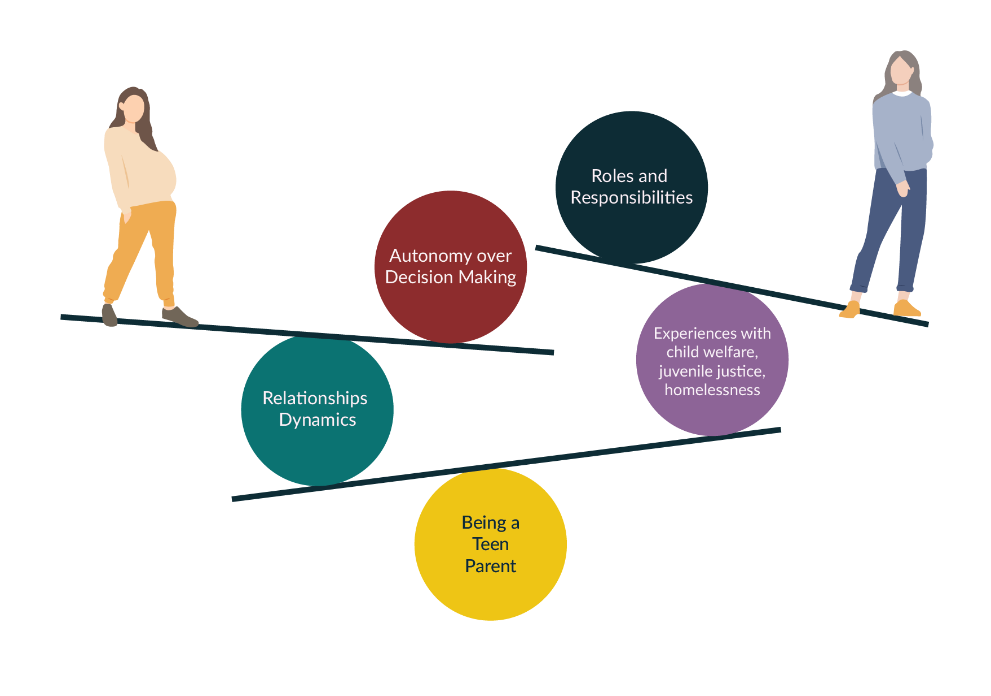
Young parent-caregiver relationships: Shifting dynamics, conflicts, and complexities

Holistically supporting young parents (e.g., adolescent parents) involves attending to the relationships that they have with their own parents/caregivers—especially when these young parents are often parenting while being parented. For young parents who have experiences with the child welfare and/or juvenile justice systems, homelessness, and/or disconnection from school or work, relationships with caregivers may be subject to additional complexities or challenges; however, research in this area remains underdeveloped.36,37 In some cases, conflict can lead to a young person being kicked out of the home, which may affect their likelihood of becoming homeless, engaging in risky behaviors, or dropping out of school.38 Although the research about young parents is limited, youth-supporting professionals can help young parents and their adult caregivers navigate these challenges and foster an environment in which both the young parent and their child(ren) can thrive.39
Adolescents’ transition into parenthood marks a significant turning point in the adolescent-caregiver relationship.40 One unique study explored the experiences of mothers of adolescent parents during their transition to early grandparenthood, finding the transition to be abrupt and challenging for some families.41 Caregivers’ reactions to and feelings about their adolescents becoming a parent can include anger, fear, disappointment, or excitement.42,43 Meanwhile, young parents in some studies have reported not feeling emotionally supported by their parents or other caregivers during their transition to parenthood.44 Juggling the interpersonal and logistical demands associated with young parenthood can be very challenging, as illustrated in this quote from a young mother (one of 31 participants interviewed in a randomized control trial of the Minding the Baby® home-visiting program):
“I had three kids, and I didn’t have a job. I was still stayin’ home with my mom. It was just stressful. I didn’t have no income … We were all sharin’ one bedroom, so that was very stressful. Then just dealin’ with tryin’ to understand how everybody feels, the kids, me, my mom at that time, how everybody was feelin’. It was stressful.”45
In some cases, the arrival of a new baby can lead to closer relationships between adolescents and their caregivers—even if their relationship had previously been strained or the caregiver was not happy about the adolescent becoming a parent.46,47 For instance, in one study of young people experiencing homelessness, youth reported that, despite complex dynamics, they relied on help from family members or service providers when pregnant or parenting; these relationships served as supportive assets while parenting.48 Other research has found that young mothers (ages 13–19) most commonly reported their mothers as a source of support immediately postpartum.49
Adult caregivers can provide critical support that benefits both the young parent and the young parent’s child(ren).50 For instance, the quality of the young mother–grandmother relationship is positively associated with the quality of the young mother’s parenting.51 Research also suggests that social support is important for the development of young parents’ identities as parents.52 Another study found that perceived social support during pregnancy was positively associated with adolescent parents’ self-reported parenting efficacy and parenting satisfaction postpartum.53 One study found that rural adolescent mothers recognized the value of getting help from their families, but also described a paradox wherein relying on that support may suggest acknowledgement that they lacked parenting-related competence.54 Maternal support or support from other family members may decrease over time while relationship strain may increase.55 Other research has indicated that family-related stress can adversely affect a young mother’s maternal self-esteem56 and that lack of support can be related to experiencing postpartum depression.57
Autonomy and decision-making power
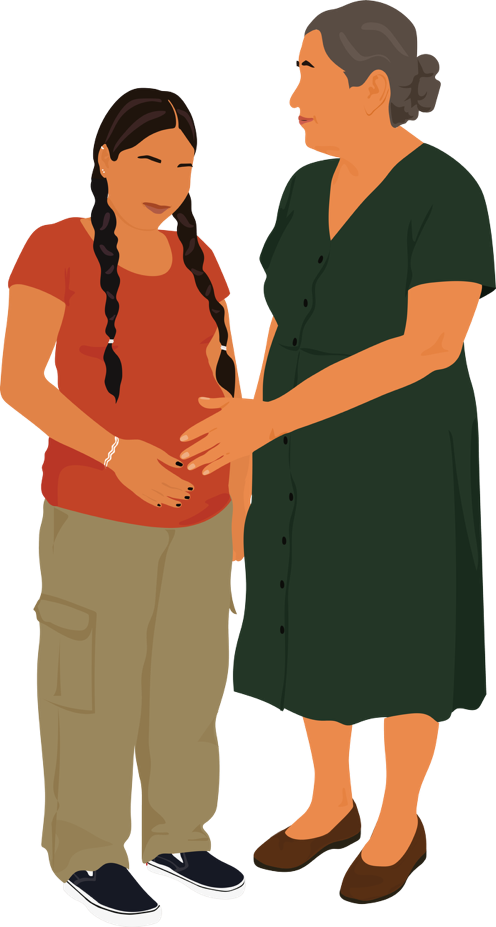
Negotiating independence (e.g., autonomy to make decisions) is normal for adolescents and their parents and/or other caregivers.58 A key part of this negotiation for young parents and their adult caregivers is determining how much autonomy the young parent has to make decisions about—and be “in charge of”—their child(ren)’s care. For example, some young mothers who had children as teenagers perceive a tradeoff between their own autonomy and the help they received from family during the transition to parenthood.59 One young mother said:
“But like, um his [child’s father] mom would help with the bath and I didn’t like that at all. Like, I liked that she helped but like she was “you’re doing it this way, you’re doing it this time, this is what you do.” Like she wasn’t like “okay well you do this, you help me.” It was “let me do it,” let—she wasn’t teaching. She was “well let me have her, let me do it.”60
Research has found that grandparents who mentor their adult children through the transition to parenthood try to strike a balance between their desire for involvement with a desire to not overstep (e.g., “I only give advice when I’m asked”).61 However, the dynamics are likely to be different in the case of young parents who are still being parented themselves.
In many cases, young people who are involved in the child welfare or juvenile justice systems already lack autonomy62,63 and face higher levels of surveillance by professionals, including caseworkers, foster parents, group care staff, and judges.64,65,66 Court systems reinforce power dynamics by being heavily involved in the daily decisions around—and options that are granted to—youth in the child welfare or justice systems. Restrictions on young parents’ autonomy may be further compounded by perceptions that they are immature or unfit to parent.67,68 Data from various child welfare databases indicate that children of young parents are more likely to face child protective service (CPS) investigations around maltreatment/neglect.69 Each of these negative perceptions limits young parents’ ability to make decisions for themselves and their children, inhibits where they can and cannot go, and diminishes their access to choices.70
Young parents and their adult caregivers may have different parenting styles or approaches informed by developmental maturity, personal background, and life experiences. In a study comparing the parenting behaviors of young mothers (under age 25) and adult mothers (ages 25 and older), researchers found that young mothers were less likely to use positive parenting strategies and more likely to use discipline practices such as spanking or time out. In the study, differences in parenting styles were often attributed to the developmental stage of young parents, who may not fully understand child development and require additional parenting guidance from their caregiver.71 Another study found that adolescent mothers required support to provide nurturing care and responsive caregiving for their young children.72 Conflicts between adolescent mothers and their adult caregivers frequently centered around the adolescent mother’s childrearing decisions and caregivers’ concerns about the adolescent mothers’ choices or priorities.73 Fostering stronger, supportive relationships between young parents and adult caregivers can lead to more conversations and modeling of positive parenting that does not undermine young parents.74
Roles and responsibilities
Many young parents live with their own parents or adult caregivers, even when they are legally able to live independently.75 Adult caregivers can provide housing, financial support, child care, or support with decisions about the young child’s care.76,77,78 Young parents need and benefit from these concrete supports. In one study, direct infant care supporta provided by a parent figure was associated with young mothers’ increased sensitivity to their infants during interactions – a key indicator of healthy attachment between mother and child.79 Black adolescent mothers who received financial support from their parents around the time of their child’s birth were five times more likely to be enrolled in school or graduate by their child’s first birthday than those who did not receive parental financial support.80 The findings demonstrate the importance of financial support for young parents, even after accounting for other factors such as living situation, emotional support, or demographic characteristics.
Living arrangements and child custody
The living arrangements of young parents and their children can be more complicated when youth are experiencing homelessness or involved with the child welfare or juvenile justice systems.
- Homelessness. Many young parents experiencing homelessness rely on relatives or other adults to care for their children during periods of housing instability, which complicates roles and responsibilities among family members. One study found that only 32 percent of young women and 8 percent of young men ages 18–25 experiencing homelessness had physical custody of one or more children.81 However, few shelters serve parenting youth under age 18, and some “family shelters” (for all ages) exclude males ages 13 or older.82,83,84 These age restrictions limit young parents’ ability to provide basic needs such as housing for their child(ren).85
- Child welfare system. By definition, adolescent parents in foster care do not live with their parents. Their primary caregivers are temporary foster caregivers, kinship caregivers (e.g., extended family) or support staff in congregate care facilities or independent living placements. Even after exiting foster care (e.g., to reunification or adulthood), young people may have complicated feelings about their relationship with the families and caregivers from whom they were removed.86 In addition, monitoring or surveillance can be an obstacle for young parents in foster care, who generally experience additional scrutiny by adults in their lives.87,88,89 Both monitoring and surveillance can lead to young parents’ loss of custody and require adult caregivers to take on caring for the young child.90,91,92
- Juvenile justice system. Young parents who are incarcerated do not live with their children and may have little in-person contact with them. Few juvenile justice facilities have child-friendly spaces, facilitate communication between parents and children, or accommodate child visitation.93,94,95 Consequently, adolescent parents who experience the justice system must rely on relatives or other adults for physical custody of their young child(ren). While much research is not exclusive to young parents, the reliance on relatives or other adults leads to stress and tension as young parents and their adult caregivers negotiate roles and responsibilities, including child visitation.96,97,98,99
Conclusion
More research is needed regarding relationships between young parents and their adult caregivers – particularly among young parents who experience the child welfare system, juvenile justice system, or homelessness.100,101 To date, most of the existing research has focused on young mothers and their mothers (i.e., the maternal grandmothers of young mothers’ children). As such, the current evidence base may not be generalizable to young fathers or to relationships between young mothers and non-parental caregivers.
Although society often stigmatizes young parenthood,102,103,104 many young parents view their new role as a source of motivation and hope for the future, and an opportunity to create a positive upbringing for their children.105,106 Building on the knowledge from positive youth development, additional research could support the development of programs that foster and strengthen positive relationships between young parents and their adult caregivers.107,108 A clear understanding of the balancing act of adolescence and parenthood will help professionals provide guidance and necessary supports to strengthen the relationship dynamics between young parents and their caregivers.
Footnotes
- Direct infant care support was measured using eight items: “feed the baby,” “dress the baby,” “put the baby to bed at night or for a nap,” “take the baby for walks or visits,” “play with or keep her/him occupied,” “change the baby’s diaper,” “protect her/him from harmful things,” and “get up at night with the baby”. ↩