Introduction
How to Decode Signs of Sexual Cyberbullying and Support Teens and Youth explains how to identify, recognize, and support youth who may experience and/or engage in sexual cyberbullying.a,b This primer from Activate is meant for professionals who support young people who experience the child welfare and/or juvenile justice systems, homelessness, and/or disconnection from school and work (i.e., opportunity youth).
Sexual cyberbullying is a broad term used to describe any sexually aggressive or coercive behavior facilitated by technology to intentionally harm, embarrass, threaten, or intimidate another person.c Youth can experience and/or engage in sexual cyberbullying.
Sexual cyberbullying is harmful to all youth, especially youth who have experienced trauma,1,2 unstable living arrangements,3 and/or a lack of supportive adults in their lives.4,5 Furthermore, some youth may rely on digital platforms to stay connected with family and friends from whom they have been separated and experience an increased risk for sexual cyberbullying.6–8
Decoding Sexual Cyberbullying Behaviors
What does sexual cyberbullying look like?
Sexual cyberbullying behaviors include:
 Sextortion
 Revenge porn
 Online Sexual Harassment
 Cyberstalking
 Nonconsensual Sexting
 Cyberdating Abuse
The chart below describes sexual cyberbullying behaviors and examples of each sexual cyberbullying behavior.
| Behavior | What is this behavior? | What could it look like? |
|---|---|---|
| Sextortion |
Non-physical way of forcing sexual favors by threatening to reveal evidence of someone’s sexual activity.9 | Receiving or sending a message claiming that an explicit image (e.g., a nude) will be shared online unless one complies with the sender’s requests.10 |
| Online Sexual Harassment |
Unwanted sexual behavior on any digital platform.11 This can occur between anyone, including family, friends, acquaintances, or strangers. | Receiving or sending an unsolicited message on Instagram asking about what someone likes/is into sexually. |
| Nonconsensual sexting |
Nonconsensual texting of sexually explicit messages or photos.12 This can occur between anyone, including family, friends, acquaintances, or strangers. | Receiving or sending a naked picture on Snapchat without consent. |
| Revenge porn |
Revealing sexually explicit images or videos of a person on the internet without the consent of the subject to cause them distress or embarrassment.13 | Distributing photographs or videos of an ex-partner, obtained via hacking or other methods. Finding an explicit image or video of oneself that an ex-partner posted without consent after a breakup. |
| Cyberstalking |
Using technology to repeatedly threaten, harass, or intimidate another person, making the other person concerned about their safety.14 This can occur between anyone. | Receiving/sending messages through a social media platform saying that one is being watched. This includes watching someone’s social media to learn where they are and arriving uninvited.15 |
| Cyberdating abuse |
Using technology to spread negative information (e.g., spreading rumors, talking badly about their body) or to direct aggression or control toward an intimate partner or romantic interest.16 | Spreading rumors about a partner or romantic interest’s sexual identity/orientation on an online gaming chat room. Or, finding hurtful comments about one’s body on a partner’s Instagram post. |
Where does sexual cyberbullying happen?
| Sexual cyberbullying can occur through: | Sexual cyberbullying can occur on: |
|---|---|
|
|
Although online platforms allow young people to communicate, and to easily and directly connect with peers, they can also be used to search for people or post information anonymously. Professionals should be aware of social media and dating apps young people frequently use, as well as their logos. A 2024 Pew Research Center publication—Teens and Social Media Fact Sheet—provides more information about how teens use online platforms.17 A recent literature review examined what is known about how sexual harassment is facilitated by dating apps.18
Social Media and Dating Apps
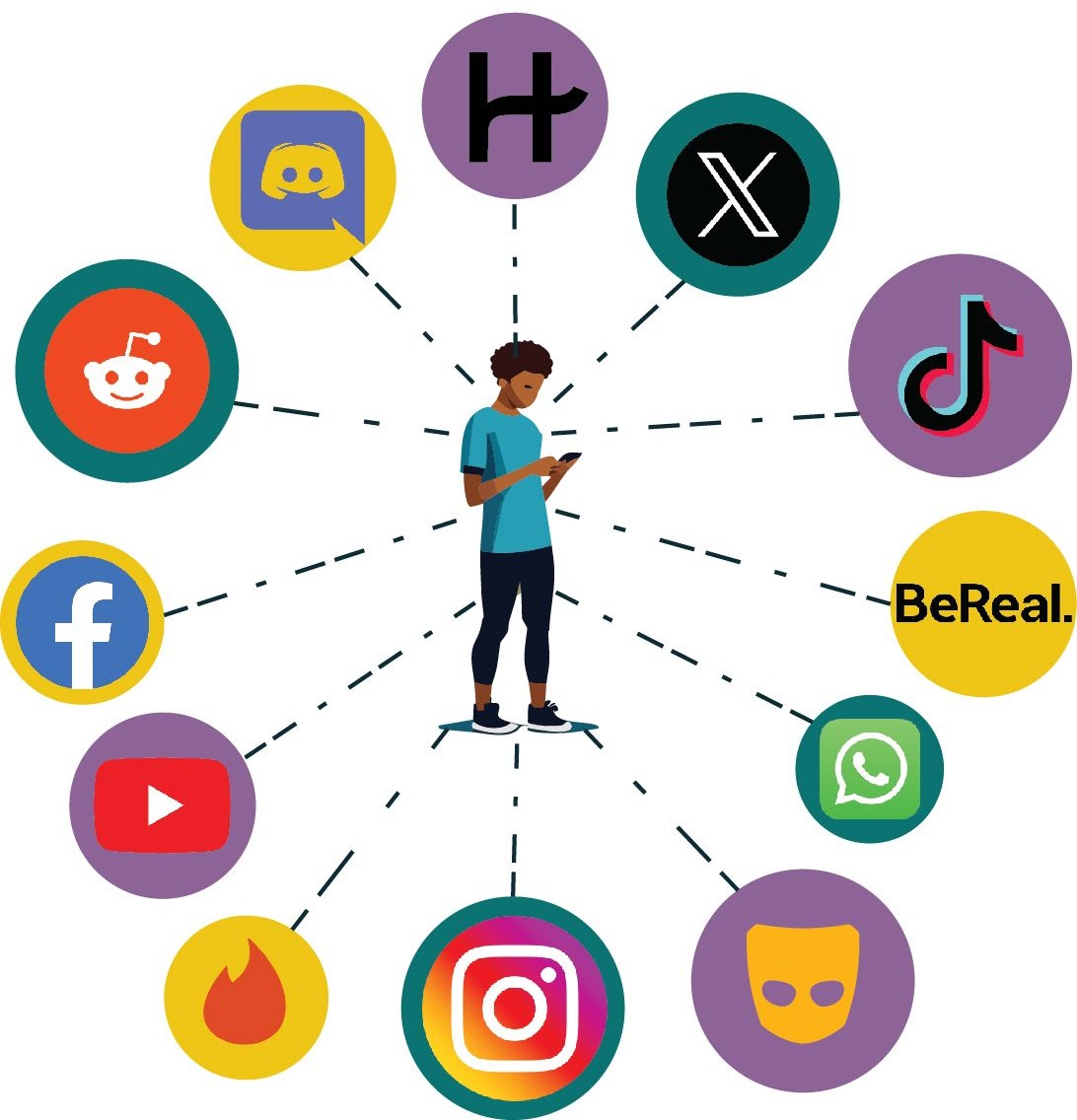
You can help youth protect themselves. Youth need to know how to use these settings for each app to protect their personal information and minimize their risk for experiencing sexual cyberbullying.19,20 Every app has its own privacy and location settings.d For example, youth should know whether their posts on different apps are public or private, whether the app is tracking their location, and whether it sells their personal information to third parties.
Decoding Signs of Sexual Cyberbullying
What are the signs of sexual cyberbullying?
Some factors may put young people at higher risk of experiencing and/or engaging in sexual cyberbullying behaviors, while others may protect young people against experiencing or engaging in those behaviors. Not all young people who exhibit risk factors will experience and/or engage in sexual cyberbullying. However, youth-supporting professionals should be aware of these factors and be prepared to talk about sexual cyberbullying with youth who exhibit them.
- First person: Did you know that youth who experience sexual cyberbullying are more likely to…
- First person: Use social media more21
- First person: Be bullied in person,22–24 and have higher levels of stress and suicidal ideation25 😕
- Second person: Wow..I heard youth who engage in sexual cyberbullying use drugs and alcohol more26
- Second person: And have lower grades27
- First person: I also read that people can both experience and engage in sexual cyberbullying
- Second person: Yeah, having low self-control28,29 and self-esteem30 are signs right?
- First person: Yes and a low sense of empathy31 and high anxiety32
- Second person: I heard parental monitoring33 and peer support34 can help protect youth from experiencing or engaging in sexual cyberbullying!
What signs of sexual cyberbullying can you listen for?
Understanding how young people describe sexual cyberbullying can help youth-supporting professionals identify when sexual cyberbullying is occurring.
In addition to slang, emojis may also have sexual connotations. Be aware that youth may talk through emojis, and the meaning of emojis change frequently. Talk with youth to determine whether they are experiencing sexual cyberbullying and/or sexually cyberbullying others.
The quotes below are examples and include vernacular terms/slang that young people and youth-supporting professionals report commonly hearing. However, slang changes over time and varies by geography and culture, among other factors. The slang used in these examples may not match the slang you hear from youth.
🍑 😘 🤩 😛 🔥 👅 ❤️ 🤤 🍆 💦 😏 😈
A youth who is experiencing sexual cyberbullying may say:
- “My bf insists I always have my location on and then always shows up where I am even if I haven’t told him. He wants to check on me.”
- “My partner insists on looking through my text messages. They don’t believe me when I tell them I am not flirting with other people.”
- “Someone online won’t stop DMing me things that make me uncomfortable. I’ve asked them to stop.”
- “My ex-partner is threatening to share my nude with their friends if I don’t continue to post pictures on social media with them.”
- “Someone DMed me a nude, but I didn’t want the picture and we didn’t talk about it first.”
- “A stranger online is asking me to send pictures and saying nasty things to me. It makes me uncomfortable.”
A youth who is sexually cyberbullying others may say:
- “I always make my partner share their location so I can know where they are and find them if I want to.”
- “I told him I’d share our sexts if he didn’t [insert any form of ultimatium here]”.
- “I made a finsta to DM a person I saw at school and ask for n00dz.”
- “My friends loved the picture (e.g., n00dz, dirties) I sent them of my gf.”
Decoding How to Help Youth
- Teach young people how to use privacy and location settings to protect their personal information and minimize their risk for experiencing sexual cyberbullying.
- Educate young people on how to use technology safely and protect themselves against malicious behavior online by teaching them the signs of sexual cyberbullying.
- Learn about sexual cyberbullying laws within your state. There is variation from state to state in what is considered sexual cyberbullying,31 so make sure you know the laws within your state and have conversations with youth about those laws.
- Have routine conversations with young people to teach them about sexual cyberbullying, including what it looks like, why it is harmful, and whether to do anything/what to do if they are experiencing and/or engaging in sexual cyberbullying.
- Discuss consent with young people and ensure they know that photos of themselves or others should not be shared without permission.
- Demonstrate support for young people who have experienced sexual cyberbullying by asking them what they need.
- Demonstrate support for youth who cyberbully others by asking about their understanding of their behavior, explaining reasons why sexual cyberbullying is not acceptable, and connecting them to services to understand the root causes of their behavior, if needed.
- Connect youth with local services (e.g., counseling, digital safety courses, legal consultation) to support their mental health and legal needs after sexual cyberbullying occurs.
| Resource | Description |
|---|---|
| Privacy Settings for Social Media Apps | A youth centered resource that shares links to privacy settings instructions for popular social media sites. |
| Project iGuardian | Program to keep teens and youth safe from online predators through education and awareness. |
| National Sexual Violence Resource Center | Center that provides information to prevent and respond to in-person and cyber sexual violence. |
| The Cyberbullying Research Center | Center that provides information to prevent, identify, and respond to instances of cyberbullying. |
| Cyberbullying Laws | Online tool that summarizes cyberbullying laws in each state. |
| What Is Consent? | Online resource to help people understand what consent looks like. |
| Without My Consent | Online resource that provides multiple tools to fight online harassment. |
| Let’s Talk Consent | A flyer explaining consent with additional resources. |
Footnotes
- The information provided in this resource is based on Activate’s summary of research on sexual cyberbullying. ↩
- We use “experience and/or engage in sexual cyberbullying” to refer to youth who experience sexual cyberbullying, engage in behaviors of sexual cyberbullying, or both. This language is purposeful and youth-supporting professionals should avoid labeling youth as victims or perpetrators in this work. ↩
- The term “cyber” may be outdated and not relevant to youth. However, it is still used in the literature. Youth-supporting professionals should consider using other terms such as online or electronic or ask young people what words they would use. ↩
- At the time of publication, Senate bill 1409: Kids Online Safety Act passed the U.S. Senate with bipartisan support and will move to the House of Representatives. The bill aims to hold tech companies such as Facebook accountable for harmful online behavior such as bullying and sexual cyberbullying. The bill requires tech companies to use a “duty of care” and default settings as the safest possible. ↩